A Guide to Notable Deep-Sky Objects
This page is a guided checklist that introduces, one by one, the representative objects most often chosen as targets in amateur observing and deep-sky astrophotography. Each object comes with an image and a short description covering its morphology, visibility, and observing tips. Figures for distance, apparent magnitude, and type follow Wikipedia and SIMBAD data; because measurement methods differ, these often span a range, and the text uses commonly cited values.
For a complete data list that can be filtered by constellation, type, or magnitude, see Object Catalog. For the physical mechanisms behind each class of object, see Galaxies, Nebulae, and Star Clusters; to determine whether a target rises at your latitude, see Hemisphere Visibility; for what magnitude means, see The Magnitude System.
Designations and naming
Section titled “Designations and naming”Deep-sky objects often carry several catalogue designations at once. M denotes the Messier Catalogue, compiled by the 18th-century French astronomer Charles Messier — 110 bright objects well suited to amateur observing; NGC is the New General Catalogue (1888), with about 7,840 objects and the most widely used numbering; IC is its later Index Catalogue supplement (~5,386 objects); Caldwell (C), compiled by Patrick Moore, adds bright objects Messier omitted. There are also specialised catalogues by type, such as Sh2 (Sharpless emission nebulae), B (Barnard dark nebulae) and Cr / Mel (Collinder, Melotte open clusters). One object may carry several numbers — for example the Orion Nebula = M42 = NGC 1976.
Why these objects are colourful
Section titled “Why these objects are colourful”Viewed through a telescope by eye, most deep-sky objects look greyish — not because they lack colour, but because their surface brightness is too low. The retina’s colour-sensing cone cells need a fair amount of light to work; in faint light only the colour-blind rod cells respond (scotopic vision), so everything looks grey. A camera is different: over exposures of minutes to tens of hours it accumulates photons, recording faint colour the eye cannot perceive. Those colours correspond to real physical processes.
Emission nebulae: emission lines from ionised gas
Section titled “Emission nebulae: emission lines from ionised gas”Emission nebulae (Orion, Lagoon, North America) are ionised-hydrogen regions (H II regions). Hot O/B stars inside flood the gas with ultraviolet light and ionise it; when free electrons recombine with the ions and cascade down through the energy levels, they emit photons at specific wavelengths — the emission lines:
| Line | Wavelength | Colour | Physical cause |
|---|---|---|---|
| Hα | 656.3 nm | deep red | hydrogen n=3→2 transition (Balmer series); the dominant red of emission nebulae |
| Hβ | 486.1 nm | cyan-blue | hydrogen n=4→2 transition |
| OIII | 495.9 / 500.7 nm | teal-green | forbidden lines of doubly ionised oxygen (O²⁺); signature of planetary nebulae |
| SII | 671.6 / 673.1 nm | deeper red | emission from singly ionised sulphur (S⁺) |
Different elements and ionisation states each emit fixed wavelengths; together they produce the reds, pinks and teals of nebula images.
Reflection nebulae: dust scattering
Section titled “Reflection nebulae: dust scattering”Reflection nebulae (the blue haze around the Pleiades) do not glow themselves; dust grains scatter the light of nearby bright stars. As with Earth’s blue sky (scattering favours short wavelengths), the result is blue.
Planetary nebulae and supernova remnants
Section titled “Planetary nebulae and supernova remnants”Planetary nebulae (Ring, Dumbbell) are ionised shells shed by dying low-to-intermediate-mass stars; OIII is often strong, giving a teal cast. Supernova remnants (Veil, Crab) combine Hα/OIII emission with synchrotron radiation from fast electrons in magnetic fields.
Galaxies: stellar populations and dust
Section titled “Galaxies: stellar populations and dust”A galaxy’s colour comes from its stellar populations: old stars in the bulge look yellow-red, young massive stars and H II regions in the arms look blue, and dust lanes appear dark brown — a near-”true” broadband colour. A single star’s colour is set by its surface temperature (approximately blackbody, Wien’s law): blue-white is hottest (O/B, tens of thousands of K), yellow is intermediate (the Sun, ~5800 K), orange-red is coolest (K/M).
How the colour is actually captured
Section titled “How the colour is actually captured”Turning real signal into a finished image depends on how it is acquired and processed — three common routes:
- One-shot colour (OSC) cameras: a Bayer red-green-blue filter array over the sensor yields colour in a single exposure, close to natural colour and the lowest barrier to entry.
- Mono camera + RGB filters: shoot red, green and blue separately and combine, with colour calibration (SPCC) against stellar photometry for the truest colour and best detail.
- Mono camera + narrowband filters (Hα / OIII / SII): each filter passes only one emission line, strongly suppressing light pollution and isolating gas structure — usable even from cities and under moonlight. With only three lines, they are mapped to the RGB channels, giving a representative rather than true colour: the common SHO (Hubble palette) maps SII→R, Hα→G, OIII→B, while HOO looks more natural.
Finally, the stacked raw data is “linear” and nearly black; it must be stretched to reveal faint signal, then colour-calibrated and denoised. So the colours in deep-sky images all correspond to real physical signal, but are stretched and remapped, and differ from what the eye sees directly. See 〔narrowband imaging〕 and 〔the processing workflow〕 for details.
Galaxies
Section titled “Galaxies”Galaxies are among the more challenging classes for astrophotography: most have a small apparent size and low surface brightness, and are imaged mainly in broadband. Apart from M31 and M33, whose large apparent sizes allow short focal lengths or even wide-angle lenses, most span only a few arcminutes and typically need a focal length of 800 mm or more to render their spiral arms and bulge. Types follow the de Vaucouleurs morphological classification.
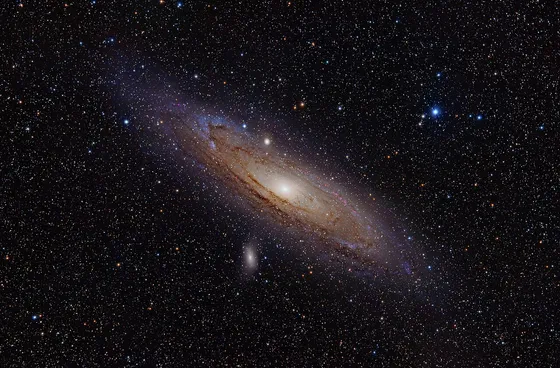
Andromeda Galaxy (M31)
Andromeda · ~2.5 million ly · mag 3.4 · SA(s)b spiral galaxy · autumn · mostly northern
M31 is the most massive member of the Local Group, containing roughly a trillion stars across a disk about 150,000 light-years wide. It is approaching the Milky Way at about 110 km/s and will merge with it in roughly 4.5 billion years. One of the most distant objects visible to the naked eye under dark skies, it appears as an elongated patch of light toward Andromeda. Its apparent size is about six times that of the full Moon, making it well suited to a 200–400 mm focal length that captures its two dwarf satellite galaxies, M32 and M110, in the same frame.
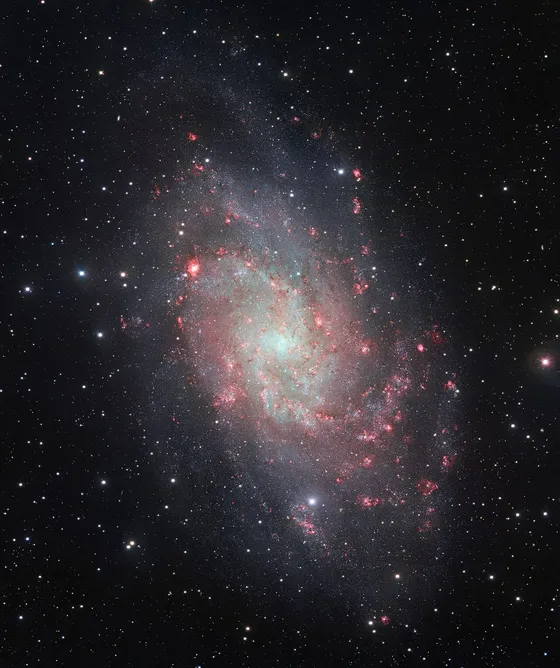
Triangulum Galaxy (M33)
Triangulum · ~2.88 million ly · mag 5.7 · SA(s)cd spiral galaxy · autumn · mostly northern
M33 is the third-largest member of the Local Group, presenting a face-on spiral disk with loose arms and numerous HII regions. Although its integrated magnitude reaches 5.7, the light is spread over such a large area that its surface brightness is very low, so it can only be picked out by the naked eye or binoculars under dark skies. Photographically it suits a medium focal length; long integration can record the pink star-forming regions in its arms, such as the famous NGC 604.
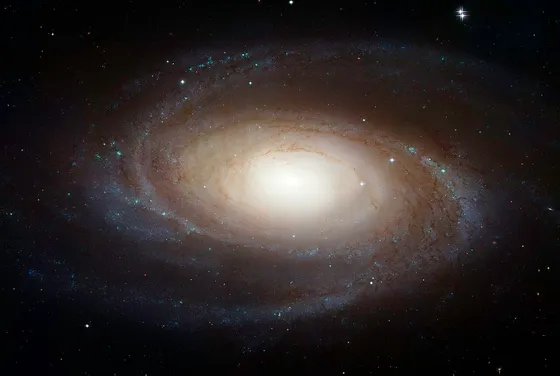
Bode's Galaxy (M81)
Ursa Major · ~12 million ly · mag 6.9 · SA(s)ab grand-design spiral · spring · mostly northern
M81 is a symmetric grand-design spiral with a bright bulge; its central region is visible even in a small-to-medium telescope. It shares a field of view with M82, and the two are undergoing a gravitational interaction. This well-known “double galaxy” pairing toward Ursa Major can be captured together at a medium focal length, making it a good entry-level galaxy target.
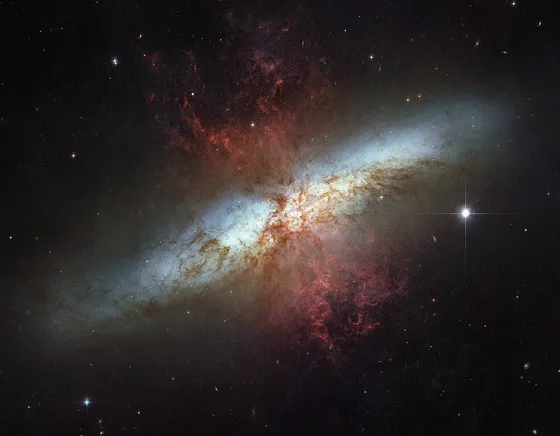
Cigar Galaxy (M82)
Ursa Major · ~12 million ly · mag 8.4 · I0 irregular starburst galaxy · spring · mostly northern
M82 is an edge-on irregular starburst galaxy whose gravitational interaction with M81 has triggered intense star formation. Its disk is dissected by dust lanes, and red H-alpha outflows—driven by supernovae and stellar winds—erupt outward from the core, standing out especially in narrowband imaging. Framed alongside M81, it is an excellent test of the resolving power of a medium-focal-length setup.
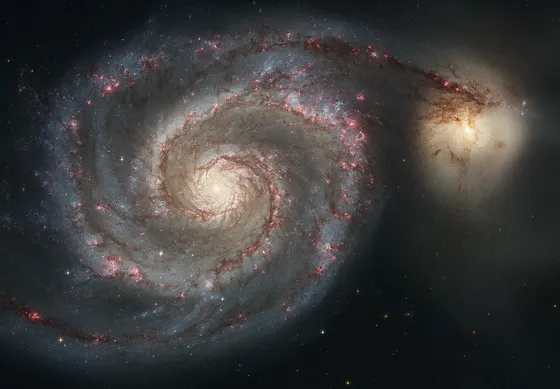
Whirlpool Galaxy (M51) + companion NGC 5195
Canes Venatici · ~23 million ly · mag 8.4 · SA(s)bc pec spiral · spring · mostly northern
M51 is a face-on grand-design spiral with clearly defined arms, undergoing a gravitational interaction with its small companion NGC 5195, which sits at the end of one of its arms. This interaction has enhanced M51’s arms and star formation. It is one of the easiest galaxies to capture with visible spiral structure, but its small apparent size demands a longer focal length and dark skies to fully reveal the detail in its arms.
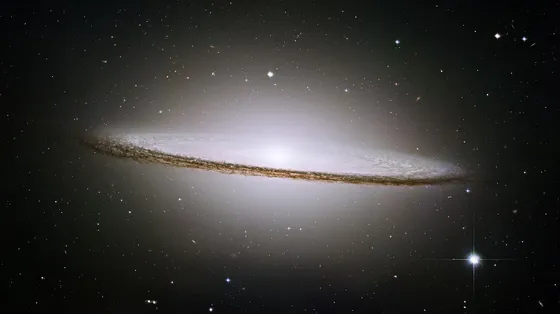
Sombrero Galaxy (M104)
Virgo · ~31 million ly · mag 8.0 · SA(s)a (classification disputed) · spring · both hemispheres
M104 is nearly edge-on, and its bright bulge combined with a dark dust lane running across the near side of the disk gives it the silhouette of a “sombrero.” It hosts a vast system of globular clusters and a supermassive black hole. Compact, bright, and sharply defined, its dust lane is recognizable even in a moderate-aperture telescope, making it a signature target toward Virgo in spring.
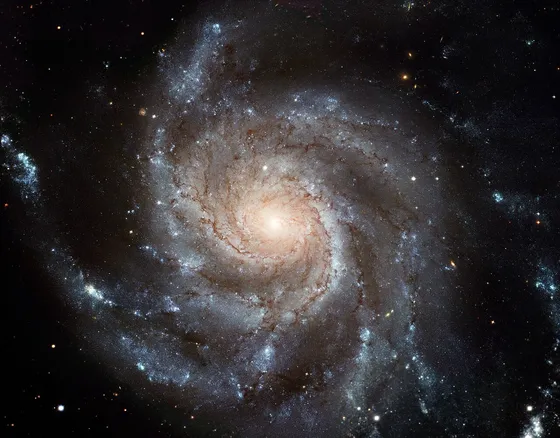
Pinwheel Galaxy (M101)
Ursa Major · ~21 million ly · mag 7.9 · SAB(rs)cd spiral · spring · mostly northern
M101 is a large face-on spiral with a disk about 170,000 light-years across—roughly twice the diameter of the Milky Way—with loose, asymmetric arms dotted with numerous HII regions. Its low surface brightness makes it hard to detect under bright skies, requiring dark conditions and long integration times. With a fairly large apparent size, it suits medium-focal-length broadband imaging, and long exposures can record the star-forming regions in its arms.
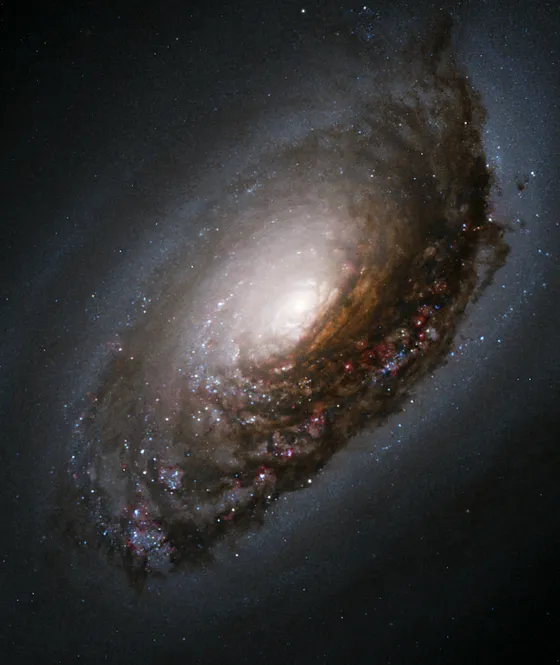
Black Eye Galaxy (M64)
Coma Berenices · ~17 million ly · mag 8.5 · (R)SA(rs)ab spiral · spring · mostly northern
M64 takes its name from the prominent dark dust band covering one side of its core, which resembles a “black eye” in a small telescope. Its inner gas and stars rotate in opposite directions, usually explained as the result of absorbing a small galaxy. This dust band is the galaxy’s most recognizable feature and requires fairly high resolution to render clearly.
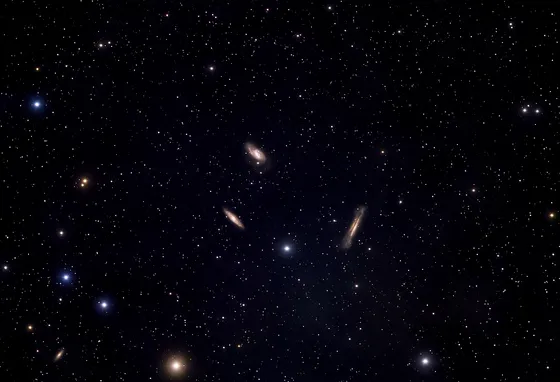
Leo Triplet (M65 / M66 / NGC 3628)
Leo · ~35 million ly · mag 8.9–9.5 · group of spiral galaxies · spring · both hemispheres
The Leo Triplet is a small group of galaxies comprising M65, M66, and the edge-on NGC 3628, all three of which fit in a single frame. M66 is the brightest, with arms made asymmetric by tidal disturbance; NGC 3628 (the Hamburger Galaxy) has a disk crossed by a dust lane and trails a tidal tail hundreds of thousands of light-years long. This is the most iconic single-frame target of spring “galaxy season,” well suited to medium-focal-length wide-field imaging.
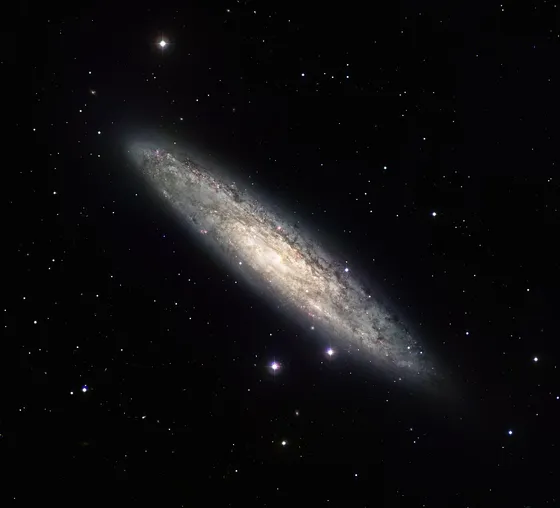
Sculptor Galaxy (NGC 253)
Sculptor · ~11.4 million ly · mag 8.0 · SAB(s)c starburst galaxy · autumn · mostly southern
NGC 253 is the principal member of the Sculptor Group, nearly edge-on, with a bright, dust-mottled disk and active internal star formation that marks it as a starburst galaxy. One of the brightest galaxies in the sky, it is observable from the southern sky and from low-to-mid northern latitudes, and its spindle-shaped outline is visible in a moderate-aperture telescope. Photographically it suits a medium focal length; long integration reveals the rich dust and bright knots across its disk.
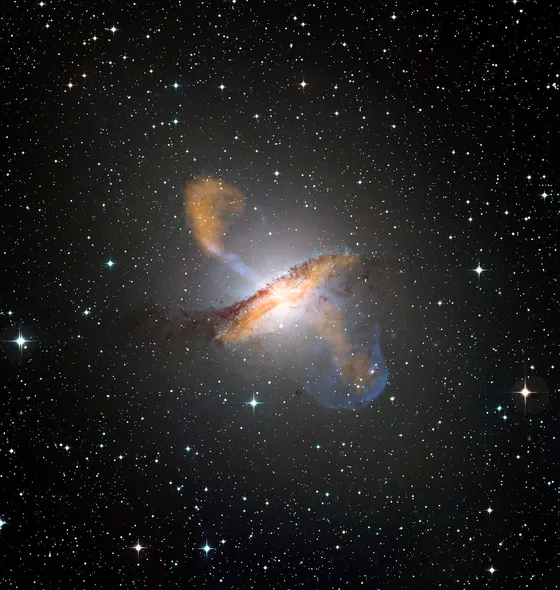
Centaurus A (NGC 5128)
Centaurus · ~11–13 million ly · mag 6.8 · S0/E pec lenticular · spring · mostly southern
Centaurus A is one of the nearest powerful radio galaxies, thought to have formed from a galaxy merger—the origin of the striking dark dust lane that crosses it. Its central supermassive black hole drives relativistic jets that extend beyond the galaxy. As a bright southern target, its dust lane is recognizable in a moderate-aperture telescope, making it a signature galaxy of the southern-hemisphere spring sky.
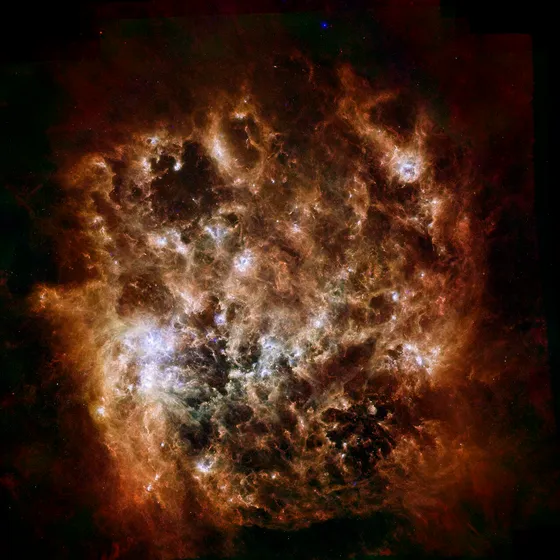
Large Magellanic Cloud (LMC)
Dorado/Mensa · ~160,000 ly · mag 0.1 · SB(s)m Magellanic-type · year-round · mostly southern
The Large Magellanic Cloud is the largest satellite galaxy of the Milky Way, appearing as a conspicuous diffuse glow visible to the naked eye in the southern sky. It contains the most active star-forming region in the Local Group—the Tarantula Nebula (30 Doradus)—along with a wealth of star clusters and supernova remnants. With a very large apparent size, it suits a short focal length or wide-angle lens for the whole object, while a long focal length can reach into local regions such as the Tarantula Nebula.
Emission Nebulae and Star-Forming Regions
Section titled “Emission Nebulae and Star-Forming Regions”Emission nebulae are clouds of hydrogen gas ionized by nearby hot, young stars—that is, HII regions—which are especially bright in H-alpha and well suited to narrowband imaging. Lower-surface-brightness targets are often imaged through H-alpha, OIII, and SII narrowband filters under urban light pollution.
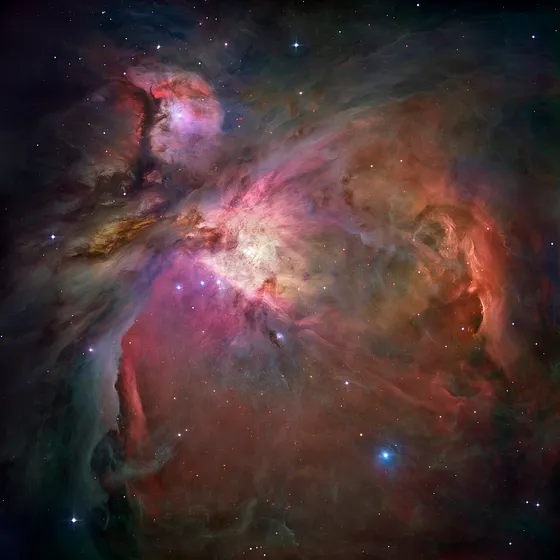
Orion Nebula (M42)
Orion · ~1,340 ly · mag 4.0 · emission/reflection nebula, HII region · winter · both hemispheres
M42 is the nearest massive star-forming region to Earth, located just below Orion’s Belt and visible to the naked eye as a fuzzy patch of light. The ultraviolet radiation from the Trapezium cluster at its center ionizes the surrounding gas, making it glow. It is the brightest emission nebula in the sky and a top first target for observing and imaging; because its bright-to-dark contrast is so extreme, it is often shot with multiple exposures blended together to capture both the core and the outer regions.
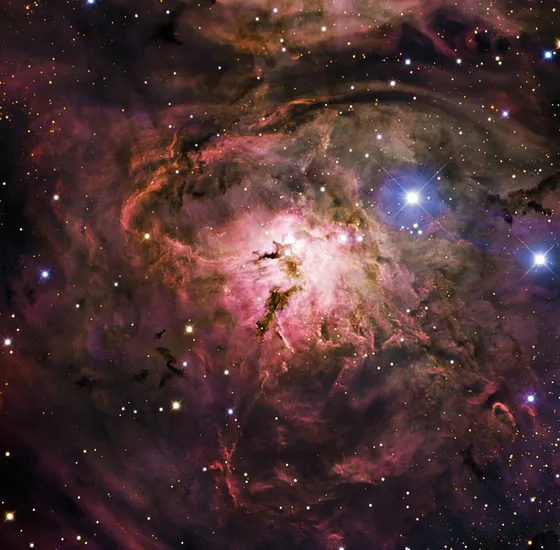
Lagoon Nebula (M8)
Sagittarius · ~4,100 ly · mag 4.6 · emission nebula, HII region · summer · both hemispheres
M8 is a bright HII region toward the Milky Way in Sagittarius, and one of only two star-forming regions visible to the naked eye from mid-latitudes. A dark dust lane through its middle gives the impression of a “lagoon,” within which the open cluster NGC 6530 and stars in the process of forming are embedded. Large and bright, it suits medium-focal-length imaging, and along the summer Milky Way it often appears together with the Trifid Nebula M20.
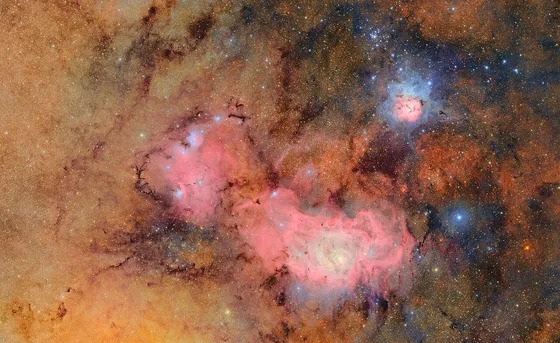
Trifid Nebula (M20)
Sagittarius · ~4,100 ly · mag 6.3 · emission + reflection + dark nebula complex · summer · both hemispheres
M20 is an uncommon complex that contains emission, reflection, and dark nebula components all at once: its red emission region is divided into several lobes by three dark dust lanes—hence “trifid”—while a blue reflection nebula borders its outer edge. It lies very close to the Lagoon Nebula M8 and can be framed together with it. Color imaging can render both the red and blue tones simultaneously, making it a classic summer target toward Sagittarius.
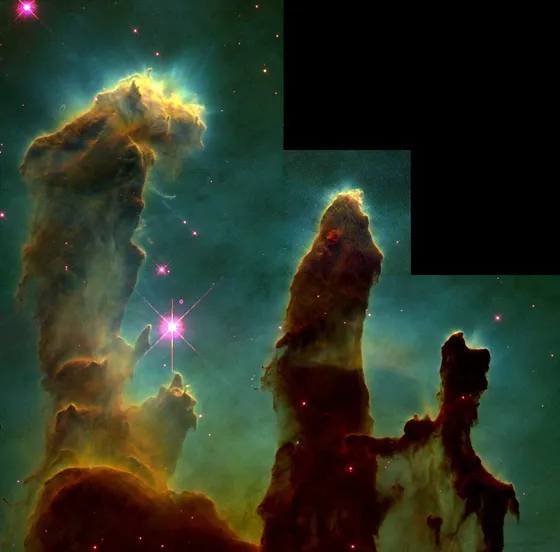
Eagle Nebula (M16, Pillars of Creation)
Serpens · ~5,700 ly · mag 6.4 · emission nebula, HII region · summer · both hemispheres
M16 is famous for the “Pillars of Creation” imaged by the Hubble Space Telescope in 1995—towering columns of gas and dust whose tips are giving birth to new stars. The nebula itself is an active HII region hosting a young open cluster. The whole object can be captured at a medium focal length, while core details such as the Pillars of Creation require a long focal length and good resolution to reveal.
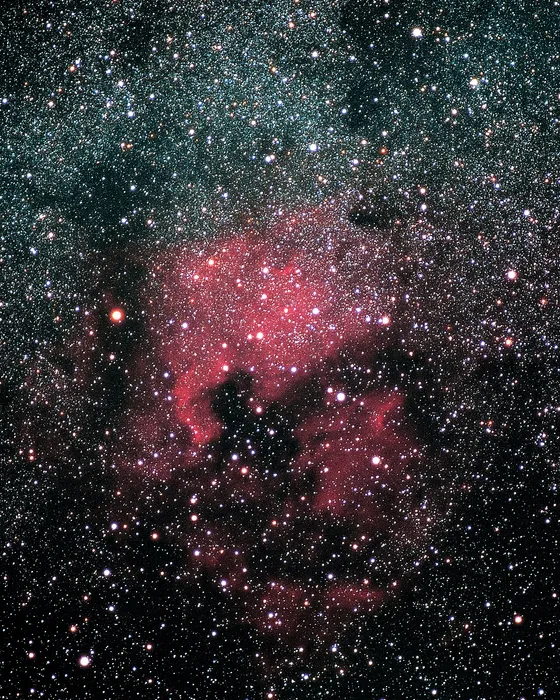
North America Nebula (NGC 7000)
Cygnus · ~2,590 ly · mag 4 · emission nebula, HII region · summer–autumn · mostly northern
NGC 7000 is named for its outline’s resemblance to the North American continent. Located near Deneb in Cygnus, it spans more than ten times the apparent area of the full Moon. Its low surface brightness makes it hard to see with the naked eye, but it is rich in structure under H-alpha narrowband or long exposures in dark skies, with the “Gulf of Mexico” region on its eastern side especially striking. Its very large field suits a short focal length or wide-angle lens for the whole object.
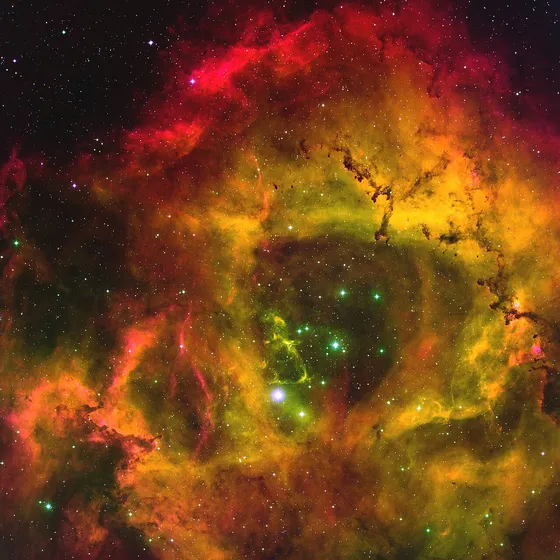
Rosette Nebula (NGC 2237 / 2244)
Monoceros · ~5,200 ly · mag 9.0 · emission nebula, HII region · winter · both hemispheres
The Rosette Nebula is a ring-shaped HII region whose center is ionized and made to glow by the young stars of the open cluster NGC 2244; the cluster’s stellar winds have blown a cavity in the cloud. The whole resembles a flower in full bloom, with an apparent size more than twice that of the full Moon. Owing to its low surface brightness, it is usually imaged through H-alpha, OIII, and SII narrowband filters, making it a signature winter narrowband target toward Monoceros.
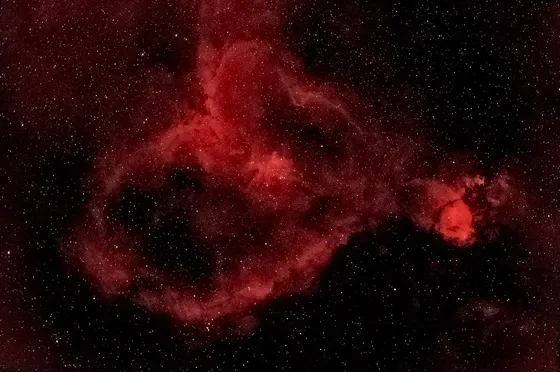
Heart Nebula (IC 1805)
Cassiopeia · ~7,500 ly · mag 6.5 · emission nebula, HII region · autumn–winter · mostly northern
IC 1805 is a large HII region in the Perseus Arm whose overall outline resembles a heart, ionized and made to glow by the central open cluster Melotte 15. Its very low surface brightness requires narrowband filters and long integration to reveal detail, and it is often included in a wide-field composition alongside the neighboring Soul Nebula (IC 1848). Its sizable field suits a short focal length or a small refractor.
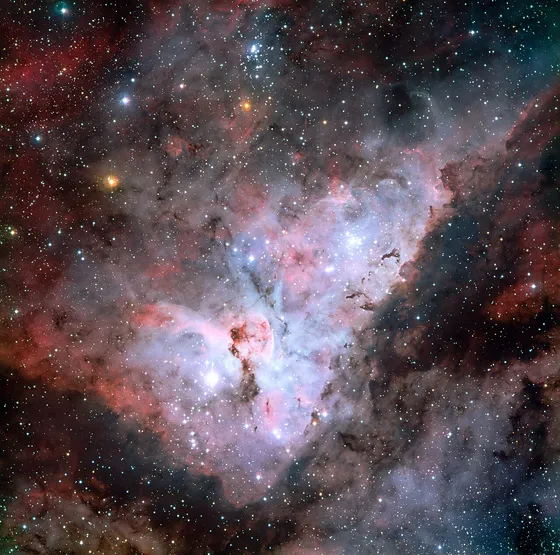
Carina Nebula (NGC 3372)
Carina · ~8,500 ly · mag 1.0 · emission nebula, HII region · year-round · mostly southern
NGC 3372 is one of the largest and brightest emission nebulae in the southern sky, with an apparent size far exceeding that of the Orion Nebula. It contains the famous luminous variable star Eta Carinae (η Carinae), which erupted in the 19th century to become the second-brightest star in the sky; the Homunculus Nebula formed from its ejecta is clearly distinguishable around it. Sharing its region with the Southern Cross, the nebula is an iconic southern-hemisphere target, well suited to medium-focal-length wide-field imaging.
Planetary Nebulae
Section titled “Planetary Nebulae”A planetary nebula is the outer shell of gas cast off by a low-to-intermediate-mass star at the end of its evolution, made to glow by ionization from the central white dwarf—it has nothing to do with planets, the name coming from the disk-like appearance these objects had in early telescopes. Most have a very small apparent size and suit a long focal length, showing strong contrast under OIII and H-alpha narrowband.
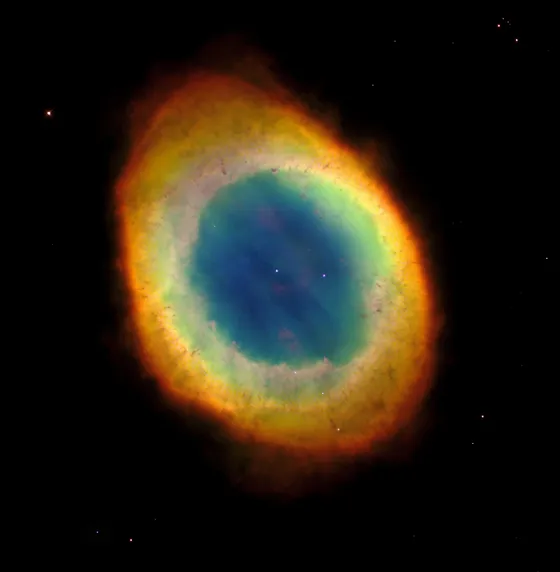
Ring Nebula (M57)
Lyra · ~2,570 ly · mag 8.8 · planetary nebula · summer · mostly northern
M57 lies between two bright stars of Lyra near Vega, making it very easy to locate, and appears as a neat smoke-ring loop even in a small telescope. The ring is a shell of gas cast off by a Sun-like star, with a very faint central white dwarf. Its small apparent size suits a long focal length or a planetary camera for enlarged imaging, making it one of the most popular planetary nebulae of summer.
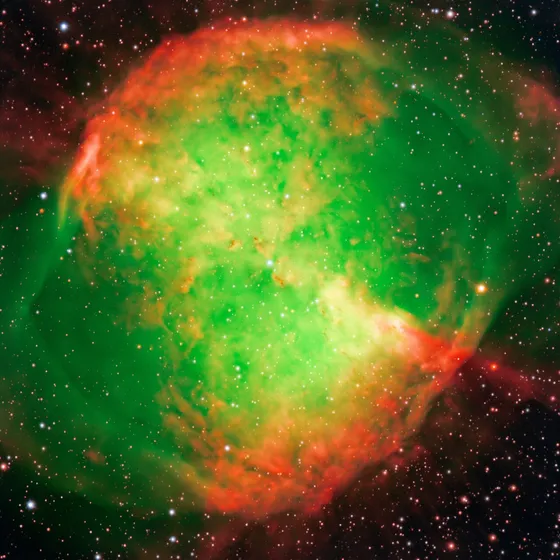
Dumbbell Nebula (M27)
Vulpecula · ~1,360 ly · mag 7.5 · planetary nebula · summer · mostly northern
M27 was the first planetary nebula ever discovered, recorded by Messier in 1764. Fairly bright and with a fairly large apparent size, its dumbbell-shaped twin-lobed structure can be made out even in binoculars. This is an entry-level planetary nebula target—its main form can be captured at a medium focal length, and OIII narrowband can also record the fainter outer shell.
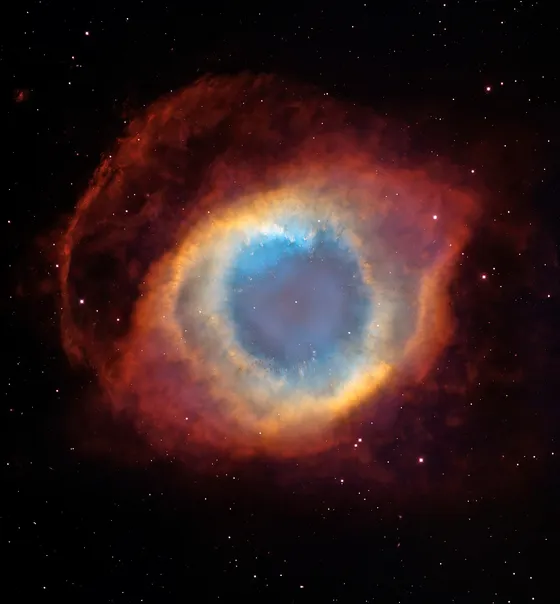
Helix Nebula (NGC 7293)
Aquarius · ~655 ly · mag 7.6 · planetary nebula · autumn · both hemispheres
NGC 7293 is one of the nearest bright planetary nebulae to Earth, with an apparent size approaching half that of the full Moon. Precisely because its light is spread over a large area, its surface brightness is on the low side, so it is actually hard to detect under bright skies. Along its inner rim are arrayed numerous cometary knots pointing toward the center. It calls for dark skies and narrowband imaging, and its large apparent size means a short-to-medium focal length is enough to fit it in.
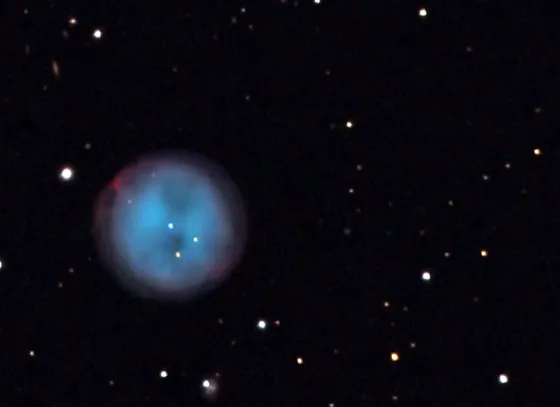
Owl Nebula (M97)
Ursa Major · ~2,030 ly · mag 9.9 · planetary nebula · spring · mostly northern
M97 lies near Merak in the Big Dipper of Ursa Major, named because two symmetric dark patches within the nebula resemble an owl’s eyes. Its low surface brightness requires fairly dark skies and a certain aperture to make out the “eyes.” Photographically it is a small, faint target suited to a long focal length combined with OIII narrowband imaging; it lies very close to the spiral galaxy M108 and can be framed together with it.
Dark Nebulae and Reflection Nebulae
Section titled “Dark Nebulae and Reflection Nebulae”A dark nebula is a dense, non-luminous cloud of dust that shows as a silhouette only against bright background gas or stars; a reflection nebula scatters the starlight of nearby stars and so appears blue.
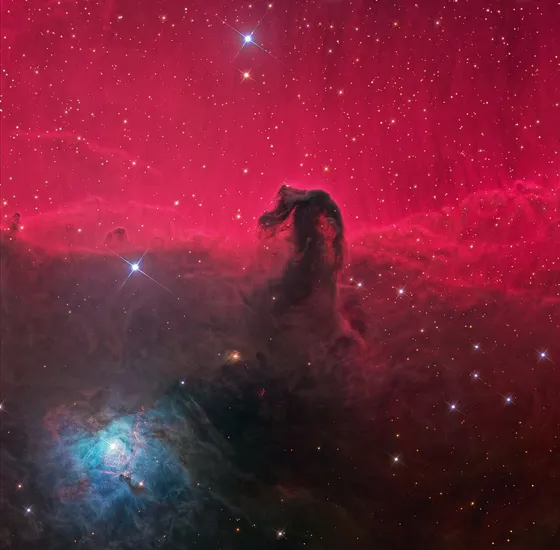
Horsehead Nebula (IC 434 / B33)
Orion · ~1,375 ly · mag — · dark nebula (silhouetted against IC 434) · winter · both hemispheres
The Horsehead Nebula is a horse-head-shaped dense cloud of dust (Barnard catalog number B33) silhouetted against the red glow of the background emission nebula IC 434. It lies near Alnitak, the easternmost star of Orion’s Belt. A classic but fairly challenging photographic target, it does not glow on its own and relies on the red background for contrast; H-alpha narrowband is often used to bring out the silhouette, and it is commonly framed with the neighboring Flame Nebula.
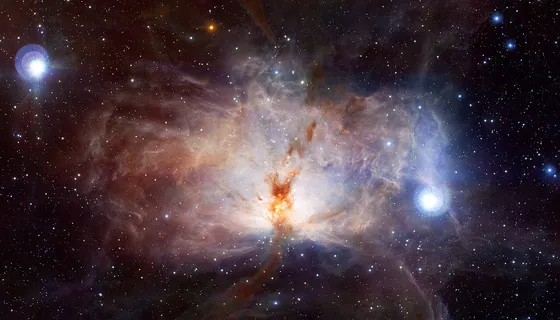
Flame Nebula (NGC 2024)
Orion · ~1,350 ly · mag — · emission nebula + dark dust · winter · both hemispheres
NGC 2024 lies right beside Alnitak, the bright star at the eastern end of Orion’s Belt, and is split into several lobes by a foreground dark dust lane, resembling dancing flames. A young, dust-obscured cluster is embedded in the nebula, observable mainly in the infrared. It shares a field of view with the Horsehead Nebula and the two are often imaged together; Alnitak is extremely bright, so care is needed to control its halo and diffraction spikes during imaging.
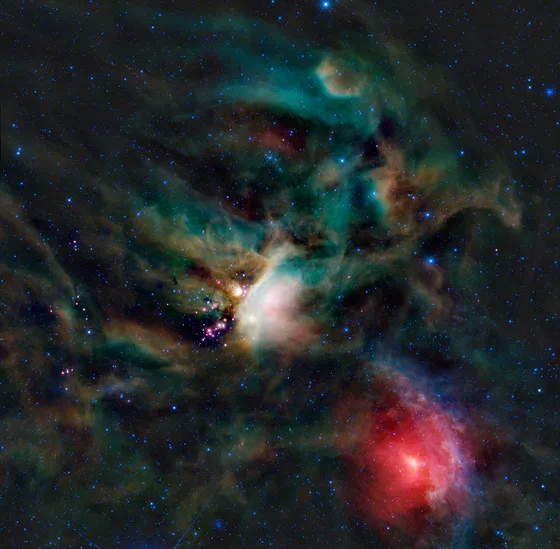
Rho Ophiuchi Cloud Complex
Ophiuchus · ~460 ly · mag — · mixed dark + reflection + emission complex · summer · both hemispheres
The Rho Ophiuchi cloud is one of the nearest star-forming regions to the Solar System and the most colorful wide-field target toward the galactic center in summer. Within it, golden dust surrounds the yellow star Antares, while blue reflection nebulae, red emission regions, and black dark dust intertwine in one place. Its very large field suits wide-field color photography with a short focal length or wide-angle lens, and it is especially spectacular under dark skies.
Supernova Remnants
Section titled “Supernova Remnants”A supernova remnant (SNR) is the rapidly expanding shell of gas ejected after a massive star explodes, often showing filamentary or ring-like structure with rich detail under H-alpha and OIII narrowband.
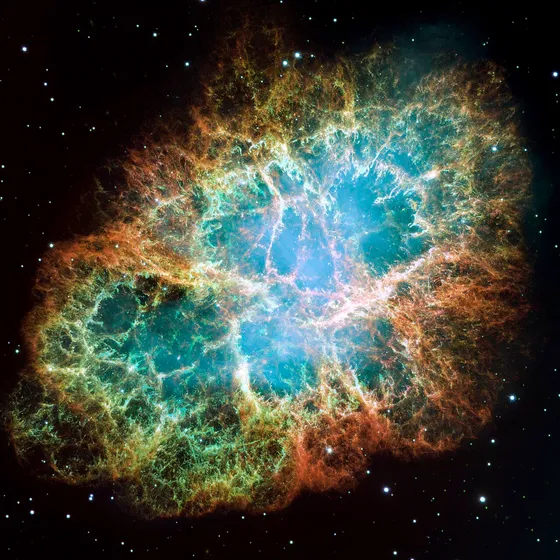
Crab Nebula (M1)
Taurus · ~6,500 ly · mag 8.4 · supernova remnant + pulsar wind nebula · winter · both hemispheres
M1 is the first object in the Messier catalog and corresponds to the “guest star” recorded in Chinese, Japanese, and Arabic astronomical accounts of the year 1054—a widely documented supernova explosion. At its center remains a rapidly spinning Crab Pulsar that drives the surrounding pulsar wind nebula. It can be made out as a fuzzy patch of light in binoculars, and photographically it suits a long focal length, with narrowband revealing its characteristic filamentary structure.
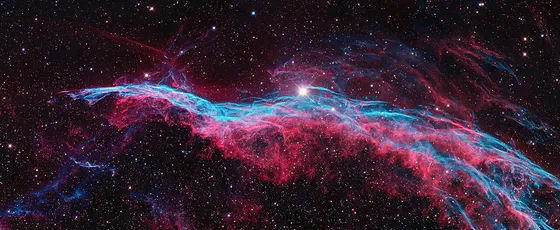
Veil Nebula (NGC 6960 / 6992)
Cygnus · ~2,400 ly · mag — · supernova remnant (filamentary) · summer–autumn · mostly northern
The Veil Nebula is an enormous supernova remnant spanning roughly 3 degrees overall (about six full Moons), left behind by an explosion some ten thousand years ago. Its two brightest parts are the Western Veil NGC 6960 (the Witch’s Broom, near the foreground star 52 Cygni) and the Eastern Veil NGC 6992. This is an iconic target for OIII narrowband imaging, with fine and intricate filamentary structure; its large field suits short-to-medium-focal-length wide-field shots.
Star Clusters
Section titled “Star Clusters”Star clusters fall into two classes: sparse, young open clusters and dense, old globular clusters. Most clusters have a fairly large apparent size and high surface brightness, making them ideal targets for binoculars and short focal lengths.
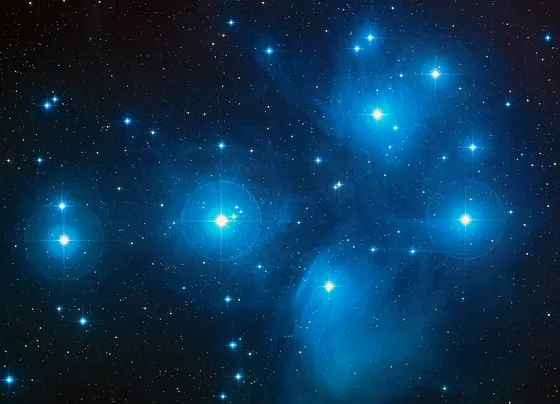
Pleiades (M45)
Taurus · ~444 ly · mag 1.6 · open cluster · winter · both hemispheres
M45 is the most conspicuous open cluster in the sky, about 100 million years old, with over a thousand members, six or seven of its bright blue stars visible to the naked eye. Long exposures reveal the blue reflection nebula enveloping it—the result of the cluster’s light being scattered as it happens to pass through a cloud of dust, rather than leftover material from the cluster’s formation. Large and bright, it suits a short focal length and is an ideal target for entry-level astrophotography.
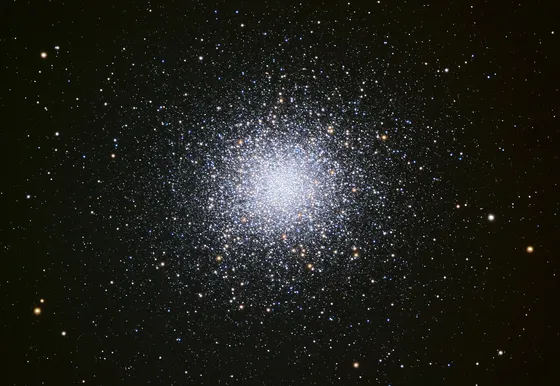
Great Hercules Cluster (M13)
Hercules · ~22,000–25,000 ly · mag 5.8 · globular cluster · summer · mostly northern
M13 is the most spectacular globular cluster in the northern sky, containing several hundred thousand stars and over ten billion years old, located on one side of the Keystone asterism in Hercules and just barely discernible to the naked eye under dark skies. A moderate-aperture telescope can resolve its outer regions into countless individual stars. It is the globular cluster most easily enjoyed by northern-hemisphere observers, and photographically a medium focal length is enough to render its densely packed member stars.
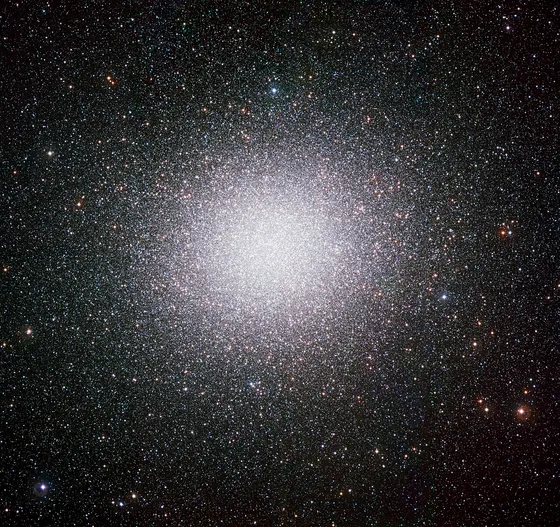
Omega Centauri (NGC 5139)
Centaurus · ~17,000 ly · mag 3.9 · globular cluster · spring · mostly southern
Omega Centauri is the largest and brightest globular cluster of the Milky Way, containing about ten million stars, with an unusual mass and structure that often lead it to be interpreted as the surviving core of a dwarf galaxy swallowed by the Milky Way. It is visible to the naked eye as a fuzzy “star,” and was indeed mistakenly cataloged as a star in early times. As a southern target it is hard to observe from mid-to-high northern latitudes, but from the southern hemisphere it is one of the most spectacular globular clusters of all.
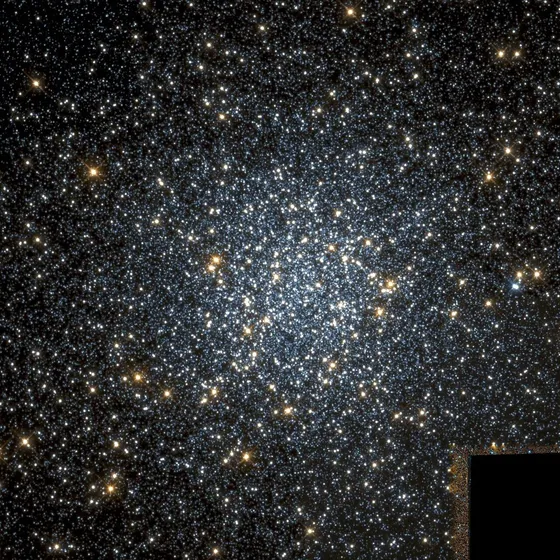
47 Tucanae (NGC 104)
Tucana · ~14,500 ly · mag 4.1 · globular cluster · year-round · mostly southern
NGC 104 is the second-brightest globular cluster in the sky, surpassed only by Omega Centauri, with a highly concentrated core. On the celestial sphere it lies right next to the Small Magellanic Cloud, but it is far closer in actual distance and is a member of the Milky Way. Its interior contains numerous millisecond pulsars and blue stragglers. As a southern target, a moderate-aperture telescope can resolve its dense core, making it a signature globular cluster of the southern hemisphere.
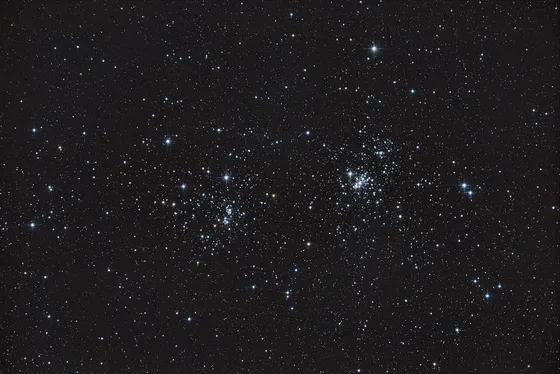
Double Cluster (NGC 869 / 884)
Perseus · ~7,500 ly · mag 3.7 / 3.8 · pair of open clusters · autumn–winter · mostly northern
The Double Cluster consists of two adjacent young open clusters, NGC 869 and NGC 884, both only about ten to twenty million years old, sharing a single field of view and discernible to the naked eye under dark skies as a bright patch within the Milky Way. They are rich in luminous blue-white giants, with striking color contrast. This is a classic binocular target for autumn and winter, and photographically a short focal length suits framing both clusters together.
References
Section titled “References”- Andromeda Galaxy — Wikipedia: distance, apparent magnitude, morphological classification, and diameter data for M31.
- Messier object — Wikipedia: the complete Messier catalog table, used to cross-check the constellation, distance, and magnitude of each M-numbered target.
- Orion Nebula — Wikipedia: the distance (~1,340 light-years), apparent magnitude, and star-forming-region nature of M42.
- Crab Nebula — Wikipedia: the distance, supernova-remnant nature, and the 1054 guest-star historical record for M1.
- Omega Centauri — Wikipedia: the distance, apparent magnitude, and member count of the Milky Way’s largest globular cluster.
- SIMBAD Astronomical Database: a professional database for querying each object’s coordinates, magnitude, and cross-identifications by designation.