The Magnitude System
Magnitude is the standard scale astronomers use to quantify the brightness of celestial objects. It expresses, on a logarithmic scale, the radiant flux received from an object in a given band, with smaller numbers denoting brighter objects. The whole system originated in the ranking of ancient Greek visual observations and was given a precise logarithmic definition in the 19th century. Magnitude ties together the observed brightness, a star’s true emitting power, and its distance, and it directly governs both the visual limit and the imaging strategy for deep-sky photography. The concepts of angle, distance, and coordinates touched on here can be read alongside Celestial Coordinate Systems and Stellar Physics.
History and Definition
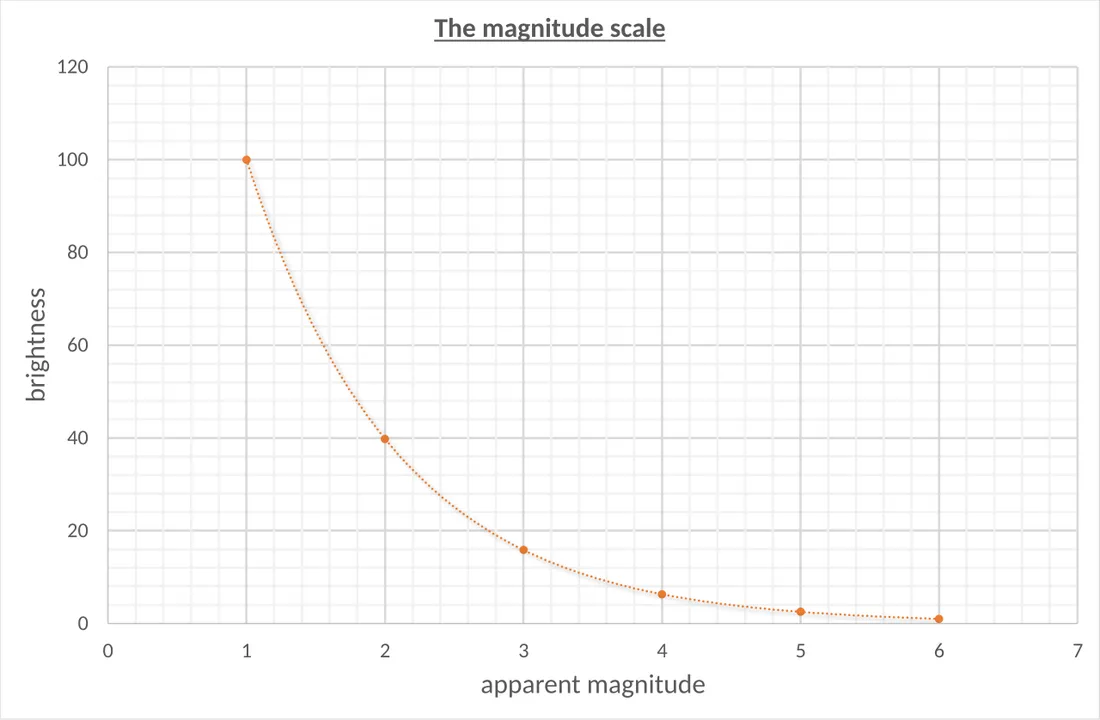
Section titled “History and Definition”The earliest surviving ranking of stellar brightness appears in Ptolemy’s Almagest and is traditionally credited to Hipparchus in the 2nd century BC. That system divided the naked-eye stars into six grades: the brightest were “first magnitude” (m = 1), and those barely visible to the naked eye were “sixth magnitude” (m = 6).
This visual ranking was essentially an approximation of the eye’s logarithmic response, but it lacked a precise numerical definition. In 1856 the English astronomer N. R. Pogson proposed a quantitative scheme: a first-magnitude star should be exactly 100 times as bright as a sixth-magnitude star, so that a difference of 5 magnitudes corresponds to a brightness ratio of exactly 100:1. This convention has been used ever since, turning the originally subjective visual ranking into a computable physical scale.
The Logarithmic Definition and the Pogson Ratio
Section titled “The Logarithmic Definition and the Pogson Ratio”The modern definition of apparent magnitude (denoted m) is a logarithmic relation. The magnitude difference between two objects is set by the ratio of their radiant fluxes (flux, F):
m1 − m2 = −2.5 log10(F1 / F2)From “5 magnitudes equals a factor of 100 in brightness” one can derive the brightness ratio between adjacent magnitudes, the Pogson ratio:
100 ^ (1/5) = 10 ^ 0.4 ≈ 2.512In other words, every difference of 1 magnitude corresponds to a brightness ratio of about 2.512; 2.512 ^ 5 ≈ 100. The coefficient −2.5 follows from this (5 / log10(100) = 2.5), and the negative sign ensures that “brighter means a smaller magnitude number,” the direction consistent with the historical ranking.
To relate apparent magnitude directly to the flux of a single object, a zero-point constant must be introduced:
m = −2.5 log10(F / F0)where F0 is the agreed reference flux (the zero point) for that band, i.e. the flux corresponding to “magnitude 0.”
Zero Points and Reference Systems
Section titled “Zero Points and Reference Systems”The absolute numerical value of a magnitude depends on the choice of zero point, and different reference systems give systematically different values.
| System | Zero-point definition | Characteristics |
|---|---|---|
| Vega system (Vega / VEGAMAG) | Uses Vega’s brightness in each band as the baseline, so that its color index is approximately zero | Historically dominant; the Johnson UBV system sets the zero point from the average of several stars of the same spectral type as Vega, so Vega’s measured V ≈ 0.03 rather than strictly 0 |
| AB magnitude system (AB magnitude) | Based on a constant flux density per unit frequency f_ν: m_AB = −2.5 log10(f_ν / erg·s⁻¹·cm⁻²·Hz⁻¹) − 48.60 | A flat-spectrum source has the same magnitude in every band; tied directly to physical flux density, convenient for spectrophotometry and survey calibration |
| Bolometric system (bolometric) | IAU 2015 Resolution B2 specifies: apparent bolometric magnitude 0 corresponds to an irradiance of 2.518 × 10⁻⁸ W·m⁻², and absolute bolometric magnitude 0 corresponds to a luminosity of L0 = 3.0128 × 10²⁸ W | Used for converting between absolute bolometric magnitude and luminosity, unifying the zero point of all-band brightness |
Vega has long been treated as the “zero-magnitude reference star,” but its precise apparent magnitude is about 0.03. The AB system is widely adopted in modern surveys (such as photometric cameras and catalog calibration) because it corresponds directly to the flux density in the frequency domain and does not rely on the spectrum of any one particular star.
Typical Apparent-Magnitude Anchors
Section titled “Typical Apparent-Magnitude Anchors”Memorizing the apparent magnitudes of a few familiar objects helps build intuition. The values below are common approximations; some objects (planets, the Moon) vary with distance and phase.
| Object | Apparent magnitude m | Notes |
|---|---|---|
| Sun | −26.74 | The brightest object in the whole sky |
| Full Moon (mean) | −12.7 | About 400,000 times fainter than the Sun |
| International Space Station (brightest) | −4 to −6 | Can outshine Venus during a transit |
| Venus (maximum brightness) | −4.6 | The “evening star / morning star” at dusk or dawn |
| Jupiter (near opposition) | −2.9 | One of the consistently brighter planets |
| Sirius | −1.46 | The brightest star in the night sky |
| Vega | ≈ 0.03 | The historical zero-point reference star |
| Naked-eye limit (dark sky) | ≈ 6.5 | Often only 3–4 under urban light pollution |
| Binoculars (10×50) | ≈ 9.5 | Depends on aperture and sky conditions |
| Large amateur telescope (visual) | ≈ 14–16 | Depends on aperture and dark-sky conditions |
| 8-meter-class ground telescope (long exposure) | ≈ 27–28 | Near the current limit of ground-based observation |
| Hubble / Webb (ultra-deep field) | ≈ 30+ | Cumulative exposure reaching the faintest targets |
Which stars and objects are visible at different latitudes and seasons is covered in Diurnal and Annual Apparent Motion and Hemisphere Visibility; the sky-condition factors affecting the limiting magnitude are covered in Observing Conditions and Sky Quality.
Factors Affecting the Limiting Magnitude
Section titled “Factors Affecting the Limiting Magnitude”The faintest magnitude that can be seen in a given observation is called the limiting magnitude. It is not a fixed value but varies with equipment and environment:
- Aperture: a telescope’s light-gathering power is proportional to the objective’s area (the square of the aperture); the larger the aperture, the deeper the limiting magnitude for point sources.
- Sky background brightness: light pollution, moonlight, and twilight raise the background and compress the detectable faint end. The Bortle dark-sky scale corresponds directly to the naked-eye limiting magnitude.
- Atmospheric transparency and seeing: extinction reduces the flux that arrives, and turbulence blurs the point images.
- Observer or detector: degree of dark adaptation and pupil size; in imaging it depends instead on exposure time, quantum efficiency, and read noise.
For imaging, the limiting magnitude also deepens as cumulative exposure time increases, which is directly related to the accumulation of signal-to-noise ratio.
Absolute Magnitude and the Distance Modulus
Section titled “Absolute Magnitude and the Distance Modulus”Apparent magnitude is “contaminated” by distance: an intrinsically faint nearby star may appear brighter than a distant giant. To compare the true emitting power of stars, absolute magnitude (denoted M) is introduced.
Absolute magnitude is defined as the apparent magnitude an object would show if it were placed at exactly 10 parsecs (parsec, pc, about 32.6 light-years) from the observer and with no interstellar extinction.
Apparent magnitude, absolute magnitude, and distance are linked by the distance modulus (distance modulus, μ = m − M):
m − M = 5 log10(d) − 5 (d in parsecs)Equivalently:
M = m − 5 log10(d / 10)The distance modulus is an important tool for measuring distance: if the absolute magnitude of a class of object is known (such as Cepheid variables or Type Ia supernovae, the “standard candles”), measuring its apparent magnitude lets you solve for the distance:
d = 10 ^ ((m − M + 5) / 5) (d in parsecs)For example: the Sun’s apparent magnitude is −26.74, but moved out to 10 parsecs its absolute visual magnitude would be only M_V = +4.83, a thoroughly unremarkable star. Absolute magnitude is a cornerstone of stellar physics, and the vertical axis of the Hertzsprung–Russell diagram uses absolute magnitude or luminosity; see Stellar Physics for details.
Luminosity, Bolometric Magnitude, and the Bolometric Correction
Section titled “Luminosity, Bolometric Magnitude, and the Bolometric Correction”Luminosity (luminosity, L) is the total energy an object radiates each second, measured in watts (W), often referred to the solar luminosity L☉ ≈ 3.828 × 10^26 W as a baseline. It is a purely physical quantity, unaffected by distance, and corresponds one-to-one with absolute magnitude.
The absolute bolometric magnitude (M_bol) covers radiation across all bands, and is related to luminosity by:
M_bol = −2.5 log10(L / L0) L0 = 3.0128 × 10^28 WEquivalently, L = L0 × 10 ^ (−0.4 M_bol). For two objects:
M_bol,1 − M_bol,2 = −2.5 log10(L1 / L2)It follows that every 5 magnitudes of absolute (bolometric) magnitude corresponds to a factor of 100 in luminosity. The Sun’s absolute bolometric magnitude is about M_bol,☉ ≈ +4.74.
In practice photometry usually measures only a single band (such as the V band), giving the absolute visual magnitude M_V. To convert from a visible-light magnitude to a bolometric magnitude covering all bands, one must add the bolometric correction (BC):
M_bol = M_V + BCBy convention the bolometric correction is negative for most stars (the all-band energy exceeds that in the single visible band alone). For very hot stars (much ultraviolet radiation) and very cool stars (much infrared radiation), the absolute value of BC is large; the Sun’s BC is about −0.08.
The distinction among the three quantities can be summarized as follows:
- Apparent magnitude (m): the brightness the observer actually sees, affected by distance.
- Absolute magnitude (M): the brightness referred uniformly to 10 parsecs, removing the effect of distance.
- Luminosity (L): the total energy radiated per second, a purely physical quantity.
Color Index
Section titled “Color Index”When the magnitude of the same object is measured in two different bands, the difference is called the color index, and the most commonly used is B−V:
B − V = m_B − m_VHere B (blue) and V (visual, yellow-green) are standard bands of the Johnson–Kron–Cousins UBV(RI) photometric system. The zero point is chosen so that A0V-type stars like Vega have B−V ≈ 0. The color index reflects an object’s color and, for stars, directly indicates its surface temperature:
| Object | Approximate B−V | Color / temperature |
|---|---|---|
| Hot O/B-type blue stars | −0.4 to 0 | Blue-white, surface about 10000–40000 K |
| Vega (A0V) | ≈ 0.00 | White, about 9600 K (zero-point reference) |
| Sun (G2V) | +0.65 | Yellow, about 5800 K |
| K-type orange stars | +0.8 to +1.2 | Orange |
| M-type red dwarfs / red giants | +1.4 to +2 and above | Red, about 2000–4000 K |
The smaller (more negative) the value, the bluer and hotter; the larger (more positive), the redder and cooler. The color index is an efficient way for photometric surveys to determine stellar temperatures and spectral types, and it is the common form of the horizontal axis of the Hertzsprung–Russell diagram. Note that interstellar dust reddens light (reddening), making the measured B−V larger, so an extinction correction is needed before determining temperature precisely.
Surface Brightness
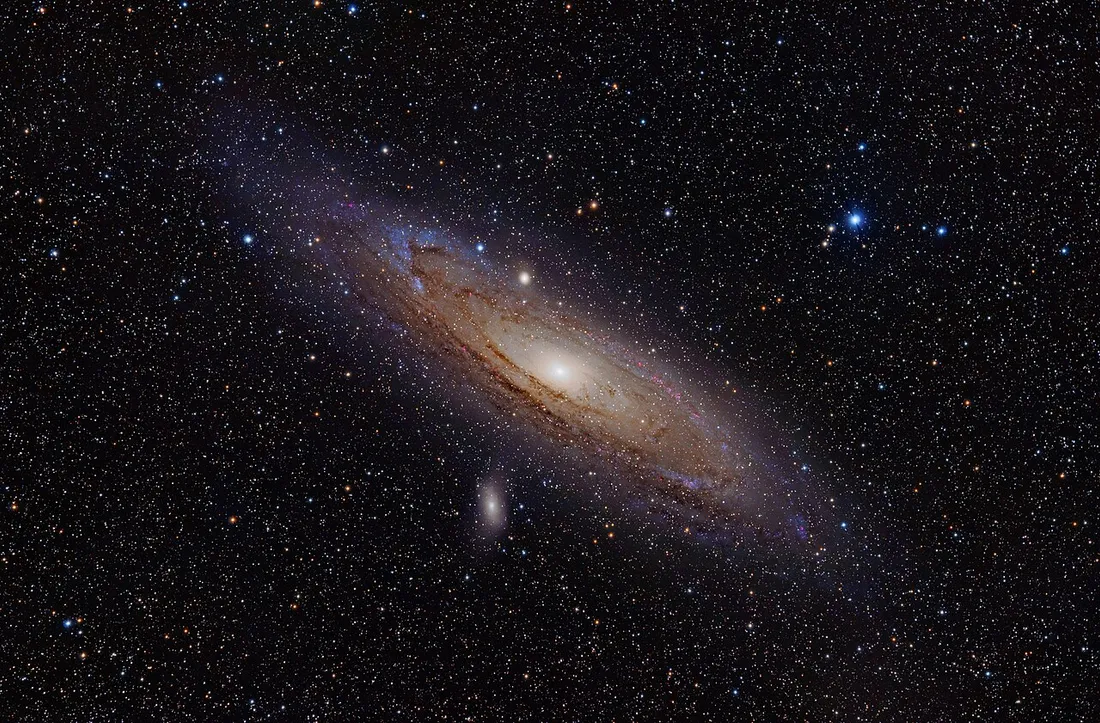
Section titled “Surface Brightness”For point-like stars, magnitude is enough to describe their brightness. But the total magnitude of extended objects such as galaxies, nebulae, and comets is “spread” over a patch of sky of finite size, so surface brightness is introduced—the brightness per unit solid angle, commonly expressed in “magnitudes per square arcsecond” (mag/arcsec²).
Surface-brightness values follow the same magnitude convention: smaller values are brighter. It is jointly determined by the total magnitude m and the target’s apparent area A (in square arcseconds):
S = m + 2.5 log10(A)For a given total magnitude, the larger the apparent area, the larger (fainter) the surface-brightness value. A common conversion: to change from “per square arcsecond” to “per square arcminute,” subtract 2.5 log10(3600²) ≈ 8.89. Typical reference values: the airglow background of a clear dark sky is about 21.8 mag/arcsec², the core of the Orion Nebula is about 17 and its outer edge about 21 mag/arcsec², and the bodies of most galaxies are about 21–23 mag/arcsec².
Surface brightness has a critical impact on both visual observing and imaging, and there is one principle that is often overlooked:
- An extended source does not become “brighter” with a larger aperture. A telescope concentrates more light into the pupil, but to see an extended source clearly you must also magnify it, and magnification dilutes the image plane in the same proportion. Increasing the magnification enlarges the image at the exit pupil and lowers the brightness per unit area; the surface brightness of the target and of the sky background change in step, and the contrast between them does not improve. Point sources (stars) are different: they have no area, so light-gathering translates directly into a deeper limiting magnitude. The real value of aperture therefore lies in improving angular resolution and the point-source limiting magnitude, not in raising the surface contrast of extended sources.
- The sky background itself has a surface brightness. When the target’s surface brightness approaches that of the airglow, no exposure—however long—can easily separate the signal from the background. This is exactly why the dark-sky scale in Observing Conditions and Sky Quality is so important.
- Imaging strategy is dictated by surface brightness. Targets with low surface brightness (large diffuse nebulae, the outskirts of galaxies) require a darker sky and more cumulative exposure, building up the signal-to-noise ratio through time.
For cross-referencing object brightness with catalogs see the Deep-Sky Object Catalog; for terminology see the Glossary.
Common Misconceptions
Section titled “Common Misconceptions”| Misconception | The reality |
|---|---|
| A larger magnitude number means brighter | On the contrary, a smaller number is brighter, and the brightest objects take negative values |
| Magnitude differences are linear | They are logarithmic: 5 magnitudes is a factor of 100 in brightness, and 1 magnitude is a factor of about 2.512 |
| A galaxy with a high total magnitude must be easy to see | The visibility of an extended object depends on surface brightness, not total magnitude |
| A larger aperture makes a nebula visually brighter | The surface brightness of an extended source does not increase with aperture; aperture mainly deepens the point-source limiting magnitude and improves resolution |
| Vega’s apparent magnitude is strictly 0 | The measured value is about 0.03; different zero-point systems give slightly different values |
| Magnitudes from different sources can be compared directly | You must verify that the band (V, B, AB, etc.) and the zero-point system are consistent |
References
Section titled “References”- Apparent magnitude — Wikipedia: the logarithmic definition of apparent magnitude, the Pogson ratio, historical origins, zero-point systems, and typical values.
- Absolute magnitude — Wikipedia: the 10-parsec definition of absolute magnitude, the distance modulus, and conversion between absolute bolometric magnitude and luminosity.
- Surface brightness — Wikipedia: the definition of surface brightness, the mag/arcsec² unit, its relation to angular area, and typical values.
- Color index — Wikipedia: the definition of the B−V color index, the UBV system, the zero point, and the correspondence with temperature.
- Magnitude (astronomy) — Encyclopædia Britannica: an authoritative overview of the magnitude concept and the distinction between apparent and absolute magnitude.