Dwarf Planets · Comets · Meteors
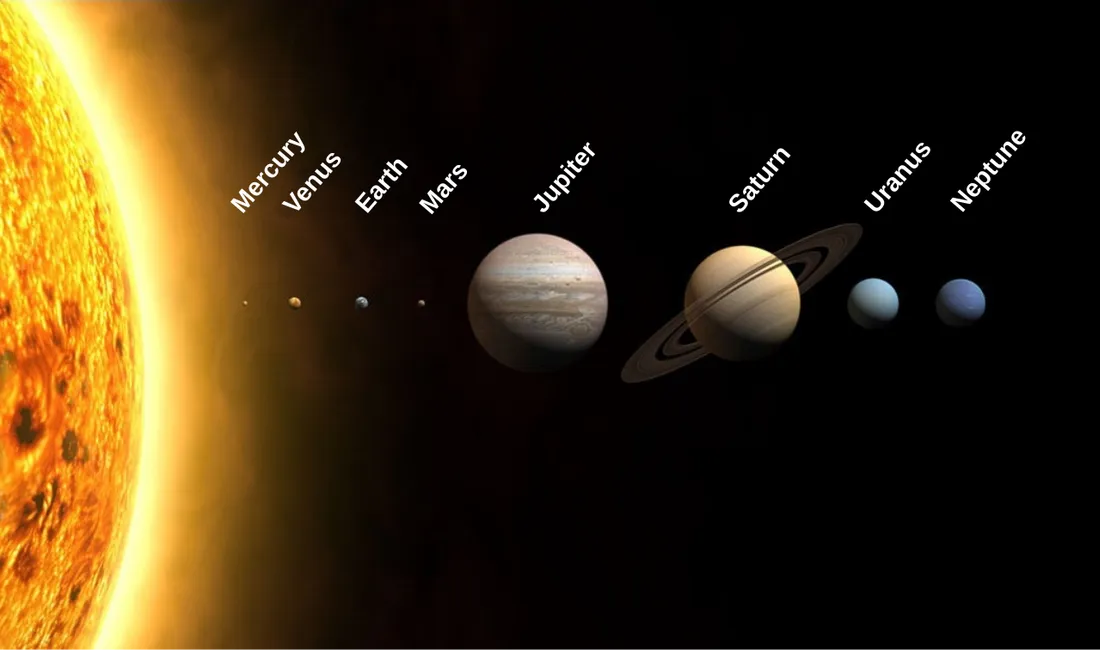
Small Solar System bodies are objects that orbit the Sun directly, other than planets and moons, including dwarf planets, asteroids, comets, meteoroids, and the meteor phenomena produced by their debris. They preserve the primordial material from the formation of the Solar System some 4.6 billion years ago; their distribution, orbits, and composition are important evidence for studying the origin and evolution of the Solar System, and they are also common targets for astronomical observation and astrophotography. This page lays out the definitions, classification, structure, and typical figures for these small bodies, and explains how they relate to observation.
Dwarf planet
Section titled “Dwarf planet”Resolution 5 of the International Astronomical Union (IAU) in 2006 provided the definitions of a planet and a dwarf planet. A planet must simultaneously satisfy three conditions: it orbits the Sun, its self-gravity is sufficient to reach hydrostatic equilibrium and assume a nearly spherical shape, and it has cleared the neighbourhood around its orbit. A dwarf planet satisfies the first two but has not cleared its orbit, and is not a satellite. The third condition, “clearing the orbit,” is the key dividing line between a dwarf planet and a planet, and was the direct reason Pluto was reclassified from a planet to a dwarf planet in 2006.
The IAU currently formally recognizes five dwarf planets. Apart from Ceres, which lies in the asteroid belt, the other four all lie beyond Neptune’s orbit in the Kuiper belt or scattered disc, and are trans-Neptunian objects (TNOs).
| Dwarf planet | Region | Mean diameter (km) | Number of moons | Year discovered | Main features |
|---|---|---|---|---|---|
| Ceres | Asteroid belt | 939 | 0 | 1801 | The only one in the inner Solar System, the largest object in the asteroid belt, once regarded as a planet |
| Pluto | Kuiper belt | 2377 | 5 | 1930 | Largest moon Charon; flown by New Horizons in 2015 |
| Eris | Scattered disc | 2326 | 1 | 2005 | The most massive dwarf planet (about 1.64×10²² kg); its discovery directly triggered the debate over Pluto’s classification |
| Haumea | Kuiper belt | ~1560 | 2 | 2004 | Extremely fast rotation (about 3.9 hours), stretched into a markedly ellipsoidal shape, known to have rings |
| Makemake | Kuiper belt | 1430 | 1 | 2005 | Surface rich in methane ice, high albedo |
The asteroid belt and near-Earth objects
Section titled “The asteroid belt and near-Earth objects”The asteroid belt
Section titled “The asteroid belt”The asteroid belt lies between the orbits of Mars and Jupiter, at about 2.1–3.3 astronomical units (AU) from the Sun, and is home to millions of rocky and metallic small bodies. Despite their enormous number, the total mass of all material in the belt is only about 3%–4% of the Moon’s, with Ceres alone accounting for about one third of it. Jupiter’s gravitational perturbations create the Kirkwood gaps within the belt and prevent the material from coalescing into a single large planet.
By composition, main-belt asteroids fall roughly into three classes:
| Type | Proportion (approx.) | Composition | Albedo | Examples |
|---|---|---|---|---|
| C-type (carbonaceous) | ~75% | Rich in carbon and hydrated minerals | Low | Ceres |
| S-type (silicaceous) | ~17% | Silicates and nickel-iron | Medium | Vesta, Eunomia |
| M-type (metallic) | The rest | Predominantly nickel-iron | Medium to high | Psyche |
Vesta (diameter about 525 km) and Pallas are the largest main-belt objects besides Ceres, but neither has reached the spherical shape of hydrostatic equilibrium, so neither is a dwarf planet.
Near-Earth objects (NEOs)
Section titled “Near-Earth objects (NEOs)”Near-Earth objects (NEOs) are small Solar System bodies with a perihelion distance less than 1.3 AU; the vast majority are near-Earth asteroids (NEAs), with a small number of near-Earth comets. Based on the geometry of their orbits relative to Earth’s orbit (semi-major axis 1 AU), near-Earth asteroids are divided into four groups:
| Group | Naming origin | Orbital characteristics | Proportion (approx.) |
|---|---|---|---|
| Amor | (1221) Amor | Orbit entirely outside Earth’s orbit (perihelion 1.017–1.3 AU) | ~35% |
| Apollo | (1862) Apollo | Semi-major axis > 1 AU, can cross Earth’s orbit | ~57% |
| Aten | (2062) Aten | Semi-major axis < 1 AU, can cross Earth’s orbit | ~8% |
| Atira | (163693) Atira | Orbit entirely inside Earth’s orbit | <0.1% |
Objects posing a potential threat are singled out as potentially hazardous asteroids (PHAs), which must simultaneously satisfy: a minimum orbit intersection distance (MOID) with Earth’s orbit ≤ 0.05 AU (about 7.5 million km), and an absolute magnitude H ≤ 22 (corresponding to a diameter of roughly 140 m or more).
Outer reservoirs: the Kuiper belt, scattered disc, and Oort cloud
Section titled “Outer reservoirs: the Kuiper belt, scattered disc, and Oort cloud”Beyond Neptune’s orbit (about 30 AU) there exist three tiers of small-body reservoirs, which are the sources of different types of comets.
| Region | Distance from Sun (AU) | Geometry | Main members | Source relationship |
|---|---|---|---|---|
| Kuiper belt | ~30–50 | Flattened ring, close to the ecliptic plane | Pluto, Haumea, Makemake, and numerous TNOs | Jupiter-family short-period comets |
| Scattered disc | ~30 to several hundred | Highly eccentric, highly inclined orbits | Eris and others | Some short-period comets |
| Oort cloud | ~2000 to over 100,000 | Spherical shell enveloping the Solar System | Inferred only from theory and cometary orbits | Long-period comets |
The Kuiper belt is composed of icy bodies and is the main source of short-period comets (especially Jupiter-family comets). The Oort cloud is a hypothetical spherical shell of icy bodies whose outer edge may extend to about half a light-year, approaching the gravitational sphere of influence of neighboring stars; perturbations from passing stars, interstellar clouds, and galactic tidal forces can push objects within it toward the inner Solar System, forming long-period comets. To this day there is no direct observational evidence for the Oort cloud; it is inferred entirely from the orbital distribution of long-period comets.
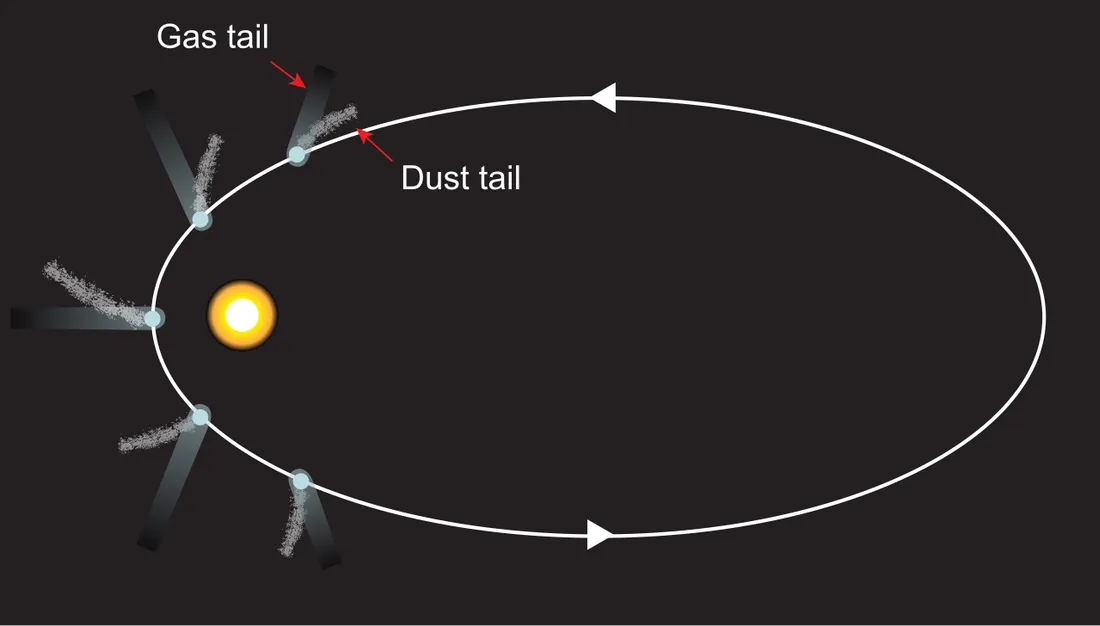
A comet is a small body composed of ice, dust, and rock, often vividly called a “dirty snowball.” When it approaches the Sun and is heated, the volatile ices sublimate and erupt, unfolding a coma and tail around the solid nucleus, and its brightness can vary dramatically over a few weeks.
Structure
Section titled “Structure”| Component | Material | Typical scale | Color / visibility |
|---|---|---|---|
| Nucleus | Water ice and volatile ices such as CO₂, CO, methane, and ammonia, mixed with silicate dust and rock | A few hundred meters to about 30 km; mean density about 0.6 g/cm³ | Solid, inactive when far from the Sun |
| Coma | An atmosphere of sublimated gas and dust | Thousands to over a million kilometers, can exceed the Sun’s diameter | A bright cloud, visible to the naked eye / telescope |
| Hydrogen envelope | Neutral hydrogen produced by the photodissociation of water molecules | Can reach millions of kilometers | Detectable only in the ultraviolet, invisible to the naked eye |
| Ion tail | Gas ionized by the solar wind (such as CO⁺) | Can reach hundreds of millions of kilometers | Bluish, straight, pointing along the solar magnetic field |
| Dust tail | Micron-scale dust pushed away by radiation pressure | Can reach tens of millions of kilometers | Yellowish-white, slightly curved, due to the influence of orbital motion |
The nucleus of Halley’s Comet (1P/Halley) is about 15×8×8 km, and that of Comet 67P/Churyumov–Gerasimenko is about 4.1×3.3×1.8 km, both irregular in shape and confirmed by close-up observation from spacecraft.
Orbital classification
Section titled “Orbital classification”By orbital period, comets are divided into two broad classes, short-period and long-period, which have different origins.
| Class | Period | Source | Orbital characteristics | Examples |
|---|---|---|---|---|
| Jupiter-family (JFC) | < 20 years | Kuiper belt / scattered disc | Low inclination (≤30°), aphelion near Jupiter’s orbit | 67P, Encke’s Comet 2P |
| Halley-type (HTC) | 20–200 years | Kuiper belt / scattered disc | Broad range of inclinations, can be retrograde | Halley’s Comet 1P (about 76 years) |
| Long-period (LPC) | > 200 years | Oort cloud | High eccentricity, arriving from all directions over the celestial sphere | Hale–Bopp C/1995 O1, Hyakutake C/1996 B2, NEOWISE C/2020 F3 |
Each time a comet approaches the Sun and brightens is called an apparition. Short-period comets have predictable apparitions; for example Halley’s Comet has returned accurately many times in history (1531, 1607, 1682, 1759, etc.), with its most recent perihelion passage in 1986 and the next expected in 2061. Long-period comets can have orbital periods of thousands or even over a million years, and are usually observed only once in a lifetime. Bright comets can be enjoyed with the naked eye or an entry-level telescope; for observing tips see /astronomy/observing/visual-techniques/, while imaging and visibility are also affected by atmospheric and light-pollution conditions, see /astronomy/observing/conditions/.
Meteoroids, meteors, and meteorites
Section titled “Meteoroids, meteors, and meteorites”Three terms describe the same material in different stages and must be strictly distinguished:
| Term | Definition | Location |
|---|---|---|
| Meteoroid | A rocky/metallic fragment in interplanetary space (scale from microns to meters) | Outside the atmosphere |
| Meteor | The phenomenon of a meteoroid entering the atmosphere at high speed and glowing as friction with the gas ionizes it (commonly called a “shooting star”) | Within the atmosphere, typically at an altitude of about 75–100 km |
| Meteorite | The residual solid that survives without being fully ablated and falls to the surface | On the ground |
The speed at which meteoroids enter the atmosphere is about 11–72 km per second; an extremely bright meteor that is brighter than Venus (about magnitude −4 or above) is called a fireball, which sometimes bursts apart in the air accompanied by a persistent train and sound; such a bursting event is also called a bolide.
Meteor shower
Section titled “Meteor shower”When the Earth passes through a stream of dust left behind along the orbit of a comet (or certain asteroids), large numbers of meteoroids pour into the atmosphere along nearly parallel paths, forming a meteor shower.
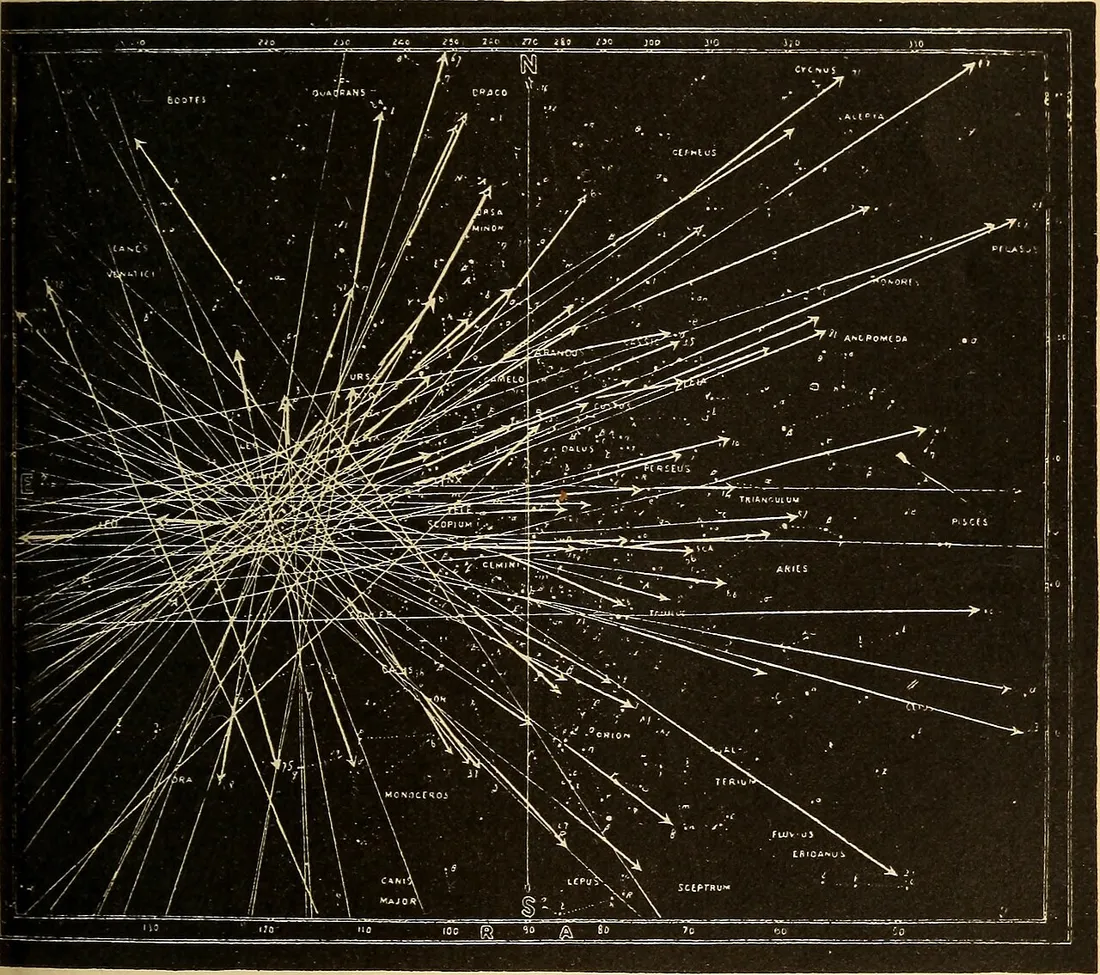
- Radiant: meteors of the same shower appear to diverge from a single point on the celestial sphere in all directions, which is a perspective effect of parallel paths; the constellation (or nearby star) where the radiant lies is the source of the shower’s name.
- ZHR (zenithal hourly rate): the extrapolated number of meteors a single observer can see per hour under the ideal conditions of the darkest Bortle level and the radiant at the zenith. The actual number seen is usually lower than the ZHR, decreasing as the radiant’s altitude drops and the sky brightens.
- Parent body: the object that left behind the dust stream, mostly a comet, occasionally an asteroid (possibly an “extinct” comet).
| Meteor shower | Peak date (approx.) | Radiant constellation | Parent body | ZHR (approx.) | Features |
|---|---|---|---|---|---|
| Quadrantids | Jan 3–4 | Boötes | Asteroid 2003 EH₁ (suspected extinct comet) | 110 | Sharp peak, lasting only a few hours |
| Perseids | Aug 12–13 | Perseus | Comet Swift–Tuttle 109P | 100 | A classic of Northern Hemisphere summer nights, with relatively many fireballs |
| Geminids | Dec 13–14 | Gemini | Asteroid 3200 Phaethon | 150 | The most reliable and abundant of the year, with an asteroid as parent body |
The Quadrantids are named after a now-defunct constellation, Quadrans Muralis, whose radiant now lies in Boötes. The Quadrantids and the Geminids are the only two major meteor showers whose parent body is an asteroid rather than a comet.
Zodiacal light and the gegenschein
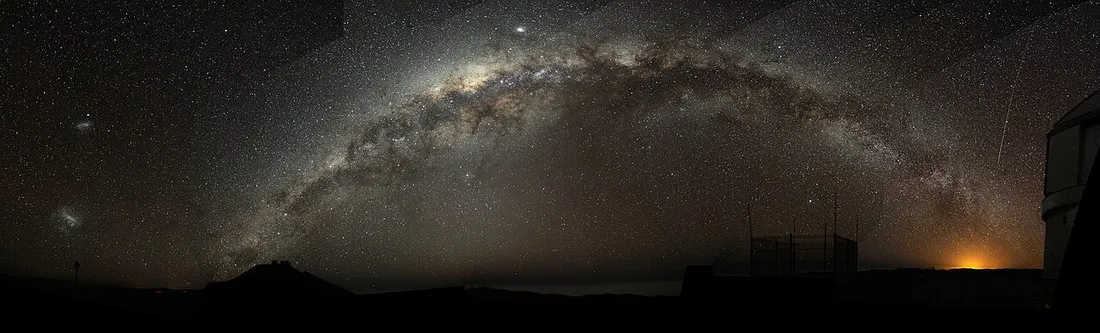
Section titled “Zodiacal light and the gegenschein”Zodiacal light is a diffuse faint glow formed by interplanetary dust scattering sunlight. This dust is concentrated near the ecliptic plane, forming a lens-shaped dust cloud centered on the Sun, so the zodiacal light appears as a cone-shaped column of light along the ecliptic, brighter near the horizon and fading upward, and tilting along the ecliptic. It is the accumulation over hundreds of millions of years of collisions among small bodies and material shed by comets, namely interplanetary dust.
The best conditions for observing the zodiacal light:
- At mid-latitudes, it is more easily seen in the western sky after sunset in spring or the eastern sky before sunrise in autumn (for the Northern Hemisphere); the zodiacal light before sunrise is commonly called the “false dawn.”
- A dark sky of Bortle 1–3 is required, and moonlight and light pollution must be avoided.
Gegenschein (counterglow) is another phenomenon formed by interplanetary dust back-scattering sunlight, appearing near the antisolar point directly opposite the Sun, manifesting as a small, slightly brighter oval patch of light, fainter and harder to discern than the zodiacal light. The extremely faint band of light that connects the zodiacal light and the gegenschein and extends along the entire ecliptic is called the zodiacal band, visible only under excellent dark skies.
References
Section titled “References”- Dwarf planet — Wikipedia: The IAU 2006 definition of a dwarf planet and the diameter, mass, and orbital data of the five members.
- Comet — Wikipedia: Cometary structure, the origin of comet tails, the short-period and long-period classification, and famous comets.
- Near-Earth object — Wikipedia: The definition of NEOs, the grouping of near-Earth asteroids, PHA criteria, and impact events.
- Zodiacal light — Wikipedia: The origin and observing conditions of the zodiacal light, gegenschein, and zodiacal band.
- Pluto & Dwarf Planets — NASA Science: An overview of dwarf planets and notes on candidate objects.
- Quadrantids / Geminids — Wikipedia: The radiants, parent bodies, and ZHR figures of the major meteor showers.