Star Clusters
A star cluster is a group of stars that formed at roughly the same time within a single giant molecular cloud and are, or once were, gravitationally bound to one another. The member stars of a given cluster share the same distance, similar ages, and a uniform initial chemical composition, with differences arising mainly from mass. Clusters are therefore a fundamental sample for testing theories of stellar evolution and for calibrating cosmic distances.
Star clusters within the Milky Way fall into two broad classes: open clusters and globular clusters. The two differ systematically in age, member count, density, spatial distribution, and metallicity. In addition, there is a class of looser, gravitationally unbound stellar collections known as stellar associations.
Open Clusters
Section titled “Open Clusters”Open clusters consist of a few tens to a few thousand member stars, loosely distributed throughout the galactic disk and spiral arms. Their members belong to Population I, that is, young stars of relatively high metallicity.
- Member count: a few tens to a few thousand; over 1,100 have been found within the Milky Way, with the actual total estimated at around 10,000.
- Age: ranging from a few million years (young) to several billion years, with most being relatively young. The oldest known open clusters (such as NGC 6791 and Berkeley 17) reach ages on the order of 10 billion years, but these are rare exceptions.
- Size: the core region is typically 3–4 light-years across, while the surrounding corona can extend to about 20 light-years; the overall diameter is generally less than 30 light-years.
- Density: about 1.5 stars per cubic light-year in the core, far higher than in the solar neighborhood (about 0.003 per cubic light-year), but still far lower than in the cores of globular clusters.
- Spatial distribution: concentrated in the galactic disk with a scale height of about 180 light-years; they occur only in spiral and irregular galaxies that have ongoing star formation.
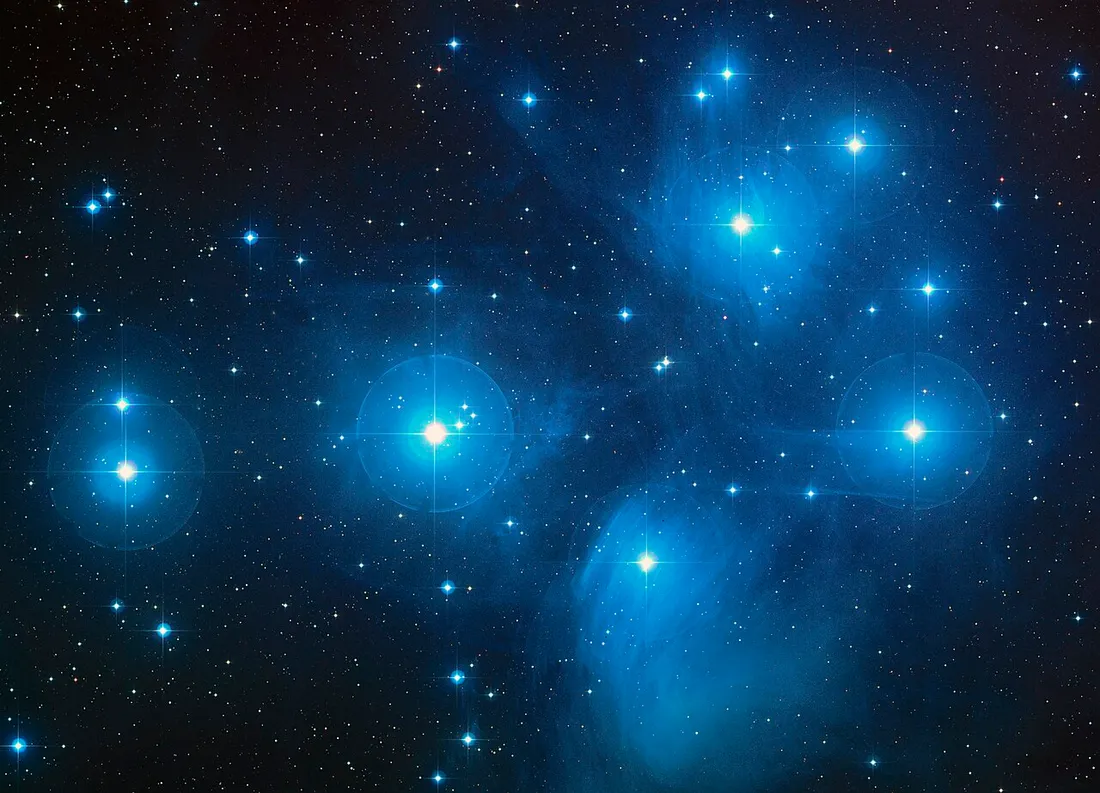
Typical examples include the Pleiades (M45), the Hyades (the nearest open cluster, about 46 parsecs away), the Beehive Cluster (Praesepe, M44), the Double Cluster (NGC 869 and NGC 884), and the Wild Duck Cluster (M11).
Formation and Dissolution
Section titled “Formation and Dissolution”Open clusters form through the hierarchical fragmentation of a giant molecular cloud, triggered by gravitational instability, supernova shock waves, or collisions between clouds. Only about 30%–40% of the cloud’s gas is ultimately converted into stars; within about 10 million years, the radiation pressure and stellar winds of massive stars blow away the residual gas, ending star formation. At this point, about 30%–50% of the initial members become unbound as the gravity of the gas is lost, and they gradually disperse.
The open cluster then orbits within the galactic disk, continually weakened by two classes of mechanisms, internal and external:
- Evaporation: gravitational scattering between internal stars gives some members velocities exceeding the escape velocity, causing them to leave.
- Tidal disruption: gravitational encounters with massive bodies such as giant molecular clouds, occurring roughly every 500 million years, strip away member stars.
The half-life over which an open cluster loses half of its members is about 150 million to 800 million years; eventually the clusters dissolve into streams of stars or stellar associations moving at similar velocities. This explains why open clusters tend to be young overall—loosely structured systems struggle to survive over long timescales.
Globular Clusters
Section titled “Globular Clusters”Globular clusters are gravitationally bound, near-spherically symmetric stellar systems that are highly concentrated toward their centers. Their members belong to Population II, that is, ancient stars of very low metallicity.
- Member count: tens of thousands to millions.
- Age: about 12 to 13 billion years, making them among the oldest objects in the observable universe; their ages set a lower bound on the age of the universe. Using the temperature of the coolest white dwarfs yields an age of about 12.7 billion years.
- Size: diameters of about 10–300 light-years; the half-light radius is usually less than 10 parsecs, with a few exceeding 25 parsecs.
- Density: about 100–1,000 stars per cubic parsec in the core (the Milky Way average is about 0.4); the average separation between stars in the core is about 1/3 light-year.
- Spatial distribution: located mainly in the galactic halo, distributed spherically around the galactic center. More than 150 are known within the Milky Way.
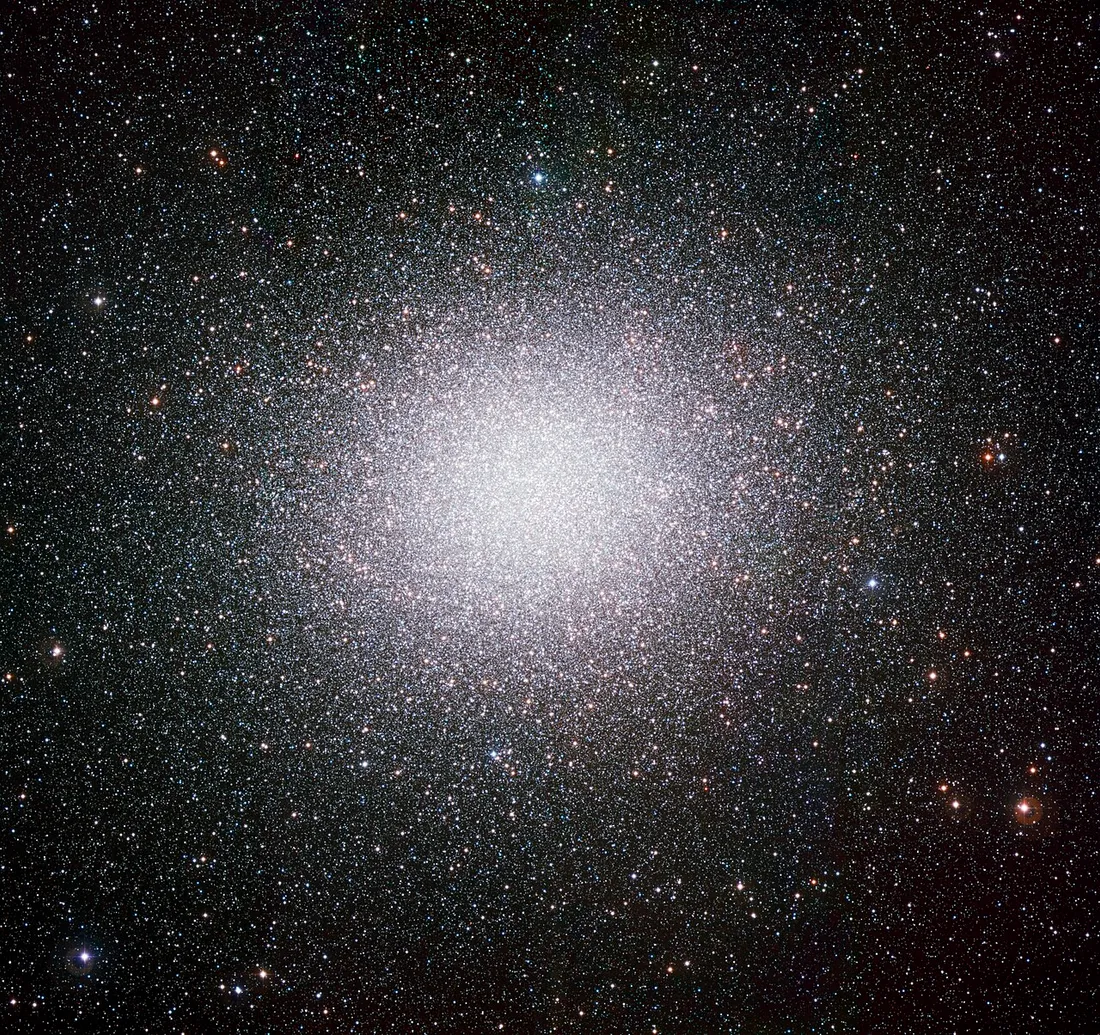
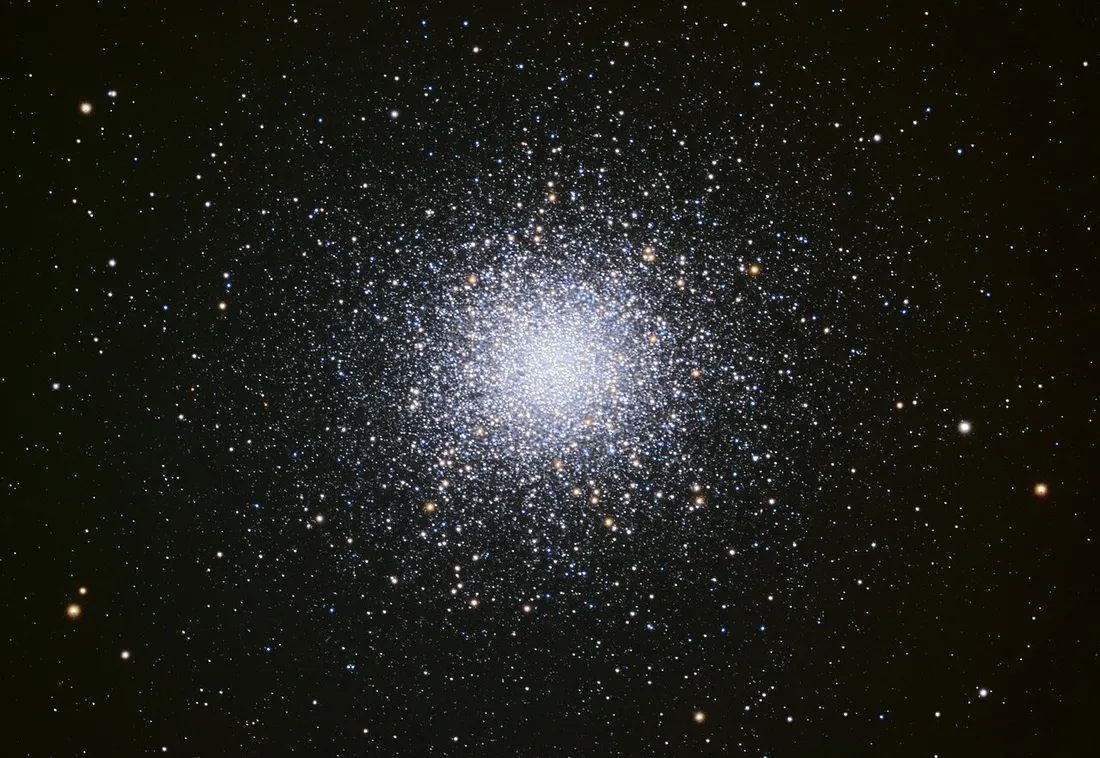
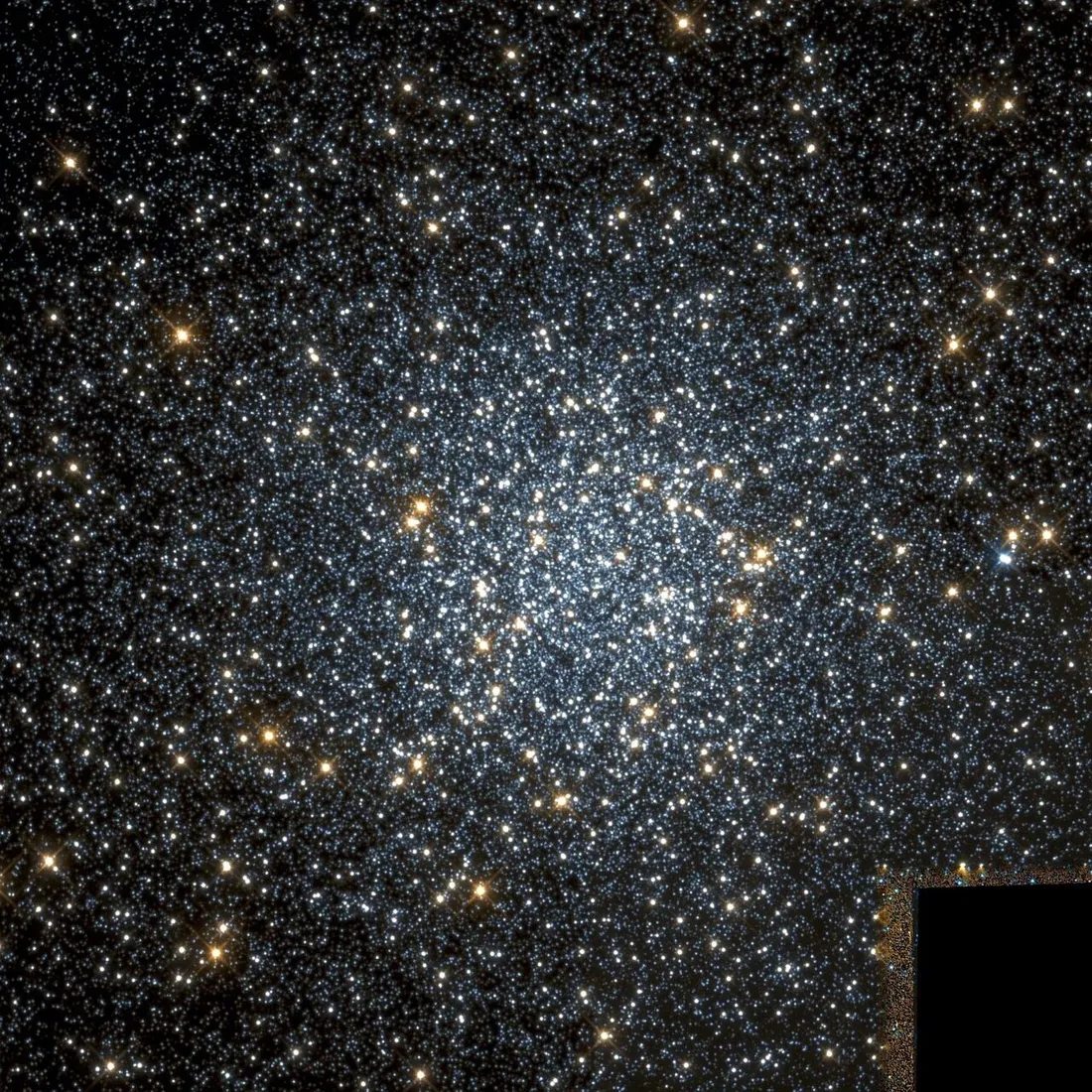
Typical examples include the Hercules Cluster (M13), Omega Centauri (NGC 5139, the most massive globular cluster in the Milky Way), 47 Tucanae (NGC 104, the second brightest), M22 (the earliest discovered, in 1665), and M15.
Core Collapse and Multiple Populations
Section titled “Core Collapse and Multiple Populations”About 20% of the Milky Way’s globular clusters have undergone core collapse: gravitational interactions transfer energy outward from the core, massive stars sink toward the center, the core density rises sharply, and a power-law spike forms in the surface-brightness profile.
The classical view once held that globular clusters were single stellar populations (uniform in age and composition), but modern observations show that nearly all globular clusters contain multiple populations—member stars that formed at different epochs or with different chemical compositions, with some clusters displaying multiple main sequences in the Hertzsprung–Russell diagram.
Because the stellar density in their cores is extremely high, globular clusters are also enriched in a variety of compact objects: blue stragglers, millisecond pulsars, low-mass X-ray binaries, and more. Blue stragglers appear younger than the cluster’s age and are generally thought to arise from binary mergers or mass transfer; they occur in both types of clusters.
Parameter Comparison
Section titled “Parameter Comparison”The table below summarizes the main differences between the two types of clusters.
| Feature | Open Cluster | Globular Cluster |
|---|---|---|
| Member count | Tens to thousands | Tens of thousands to millions |
| Age | A few million to several billion years | About 12 to 13 billion years |
| Morphology | Loose, irregular | Dense, near-spherically symmetric |
| Core density | About 1.5 stars/cubic light-year | About 100 to 1,000 stars/cubic parsec |
| Diameter | Generally less than 30 light-years | About 10 to 300 light-years |
| Spatial distribution | Galactic disk, spiral arms | Galactic halo, distributed spherically around the galactic center |
| Stellar population | Population I (high metallicity) | Population II (low metallicity) |
| Main-sequence turnoff | High (blue) | Very low (red) |
| Typical examples | M45, Hyades, M44, Double Cluster | M13, Omega Centauri, 47 Tuc, M15 |
Stellar Associations
Section titled “Stellar Associations”A stellar association is a collection of young stars even looser than an open cluster, whose overall gravity is insufficient to maintain its own structure, with a total mass of about 100–1,000 solar masses. Its members disperse at speeds exceeding the self-binding velocity and typically dissolve within about 10 million years. Stellar associations are distributed along the spiral arms and are classified into the following types according to their dominant member type.
| Type | Dominant Members | Mass Range (solar masses) | Description |
|---|---|---|---|
| OB association | O- and B-type massive hot stars | About 10 to 50 | Luminosities up to about 100,000 times solar; mark recent star-forming regions |
| T association | T Tauri variable stars | No more than about 3 | Low-mass newborn stars still in the contraction phase |
| R association | Intermediate-mass bright stars | About 3 to 10 | Surrounding dust forms reflection nebulae |
After an open cluster dissolves, it may evolve into a stellar association or moving group with similar velocities. Stellar associations are therefore a transitional stage between clustered stars and field stars.
The Hertzsprung–Russell Diagram and Turnoff Dating
Section titled “The Hertzsprung–Russell Diagram and Turnoff Dating”Because the member stars of a single cluster share the same distance, age, and initial composition, plotting all of them on a Hertzsprung–Russell diagram forms a clear sequence. This makes clusters the only sample for studying stellar evolution in which the sole variable is mass. See Stellar Physics for more.
The main-sequence turnoff is the point at the top of the main sequence where it begins to bend off toward the red giant branch. Its physical basis is that more massive stars burn their nuclear fuel faster and have shorter lifetimes, so they leave the main sequence first. As a cluster ages, the turnoff therefore shifts progressively down the main sequence from the high-mass end.
- A high, blue turnoff → a young cluster (the open-cluster side).
- A low, red turnoff → an ancient cluster (the globular-cluster side).
The main-sequence lifetime of the star at the turnoff gives the cluster’s age. This is one of the most reliable methods for determining the absolute ages of stars and clusters, and it is the basis for setting a lower bound on the age of the universe.
As a Distance Ladder
Section titled “As a Distance Ladder”Star clusters play a bridging role in the cosmic distance ladder, primarily through the following methods.
- Trigonometric parallax: applicable to nearby clusters within about 500 light-years; the Hipparcos satellite has provided reliable parallaxes for several nearby clusters.
- Moving cluster method: the proper motions of cluster members converge toward a single point on the celestial sphere, and combining this with radial velocity and geometric relations allows the distance to be solved. The Hyades is the classic target for this method.
- Main-sequence fitting: the main sequence of the target cluster is aligned on the Hertzsprung–Russell diagram with a standard main sequence of known distance, and the distance is inferred from the difference between apparent and absolute magnitude.
- RR Lyrae variables: with pulsation periods of about 0.2–1.0 days and a nearly constant mean absolute magnitude (about M_v ≈ +0.6), these serve as standard candles. Their intrinsic brightness varies approximately linearly with metallicity (about 0.25 mag per 1 dex) and requires correction. RR Lyrae stars are common in old stellar populations such as globular clusters and are usable out to about 760,000 parsecs (about 2.5 million light-years), covering the galactic halo and the Local Group.
- Cepheids: some open clusters contain classical Cepheids (for example, NGC 7790 contains three), which can be calibrated via the period–luminosity relation, extending the distance ladder still farther.
The globular cluster luminosity function (GCLF) of a cluster population can also serve as a statistical standard candle for distant galaxies; the mean absolute magnitude of Milky Way globular clusters is about M_v = −7.29 ± 0.13.
Historically, Harlow Shapley used the spherical distribution of globular clusters around the galactic center in the early 20th century to first infer that the Sun is not located at the center of the Milky Way, and to make an order-of-magnitude correct estimate of the Galaxy’s size.
Membership Determination
Section titled “Membership Determination”Determining whether a star belongs to a given cluster relies mainly on whether its kinematics are consistent with the cluster as a whole, supplemented by photometric and chemical information.
- Proper motion: members of a single cluster have similar directions and magnitudes of tangential motion on the celestial sphere; the proper motions of field stars are usually disordered.
- Radial velocity: the line-of-sight velocities of members cluster around the cluster’s systemic velocity.
- Photometric position: members should fall on the sequence corresponding to the cluster’s distance and age on the Hertzsprung–Russell diagram; stars deviating from the sequence are mostly foreground or background contaminating stars.
- Chemical abundance: the metallicity of members of a single cluster is highly uniform, allowing field stars that happen to fall within the field of view to be removed.
The high-precision proper motions and parallaxes provided by astrometric missions such as Gaia have made large-sample membership determination and contamination removal routine. The reliability of membership determination directly governs the accuracy of the Hertzsprung–Russell sequence and of turnoff dating.
Imaging Tips
Section titled “Imaging Tips”The two types of clusters differ greatly in apparent size and core density, so imaging strategies differ as well. For planning targets, refer to the site’s Object Catalog Index and Observing Conditions.
- Open clusters: usually imaged with short-focal-length or wide-angle lenses. Objects such as M45 and the Double Cluster have a large apparent size and are loose, so an overly long focal length cannot capture them fully within the field of view. The Pleiades are wrapped in faint blue reflection nebulae, which require a fairly long cumulative exposure to reveal.
- Globular clusters: usually imaged with long-focal-length lenses. The cores of M13 and Omega Centauri are dense, requiring a fairly long focal length and good seeing (see Observing Conditions) to resolve the densely packed stars of the core region into individual points of light, which is the key criterion for globular cluster imaging.
Common Targets
Section titled “Common Targets”The table below summarizes representative clusters suitable for observation with the naked eye or a small telescope. Data follow Wikipedia/SIMBAD; distances, apparent magnitudes, and other parameters differ between measurements, so the table uses common values or gives a range. For detailed entries, see Notable Objects; for actual imaging parameters and star-chart indices, see the Object Catalog.
Open Clusters
Section titled “Open Clusters”| Name | Constellation | Distance | Apparent Magnitude | Type | Characteristics |
|---|---|---|---|---|---|
| Pleiades M45 | Taurus | About 444 light-years | About 1.6 | Open cluster | Contains over a thousand members; the brightest 6–7 are visible to the naked eye, dominated by blue-white B-type stars and wrapped in blue reflection nebulae; age about 100 million years |
| Hyades | Taurus | About 153 light-years | About 0.5 | Open cluster | The nearest open cluster to the Sun; its bright stars form a V shape with Aldebaran (a foreground star, not a member); age about 625 million years, the classic target of the moving cluster method |
| Beehive Cluster M44 (Praesepe) | Cancer | About 577–610 light-years | About 3.7 | Open cluster | Contains about 1,000 members; appears as a hazy patch to the naked eye and is resolvable in a small telescope; its age and proper motion are close to those of the Hyades, about 600–700 million years |
| Double Cluster NGC 869 / NGC 884 | Perseus | About 7,500 light-years | About 3.7 / 3.8 | Double open cluster | Located in the Perseus Arm; each cluster contains over 300 blue-white supergiants, with an age of only about 14 million years; the two adjacent clusters are visible to the naked eye |
Globular Clusters
Section titled “Globular Clusters”| Name | Constellation | Distance | Apparent Magnitude | Type | Characteristics |
|---|---|---|---|---|---|
| Hercules Cluster M13 | Hercules | About 22,000–25,000 light-years | About 5.8 | Globular cluster | The most spectacular globular cluster in the northern sky; contains several hundred thousand members and is about 145 light-years across; barely discernible to the naked eye under dark skies |
| Omega Centauri NGC 5139 | Centaurus | About 17,000 light-years | About 3.9 | Globular cluster | The most massive globular cluster in the Milky Way, with about ten million stars and a mass of about 4 million solar masses; suspected to be the core remnant of a disrupted dwarf galaxy |
| 47 Tucanae NGC 104 | Tucana | About 14,500 light-years | About 4.1 | Globular cluster | The second brightest globular cluster in the sky; highly concentrated core, rich in millisecond pulsars |
| Sagittarius Cluster M22 (NGC 6656) | Sagittarius | About 10,600 light-years | About 5.1 | Globular cluster | One of the nearest globular clusters to Earth; adjacent to the galactic bulge, one of the earliest globular clusters discovered, in 1665 |
References
Section titled “References”- Open cluster — Wikipedia: definition, member count, size, density, formation and dissolution, and dating and distance-measurement methods for open clusters.
- Globular cluster — Wikipedia: member count, age, density, halo distribution, core collapse and multiple populations, and the GCLF standard candle for globular clusters.
- Stellar association — Wikipedia: definition of stellar associations and the OB, T, and R classification with mass ranges.
- RR Lyrae variable — Wikipedia: the period, absolute magnitude, metallicity dependence of RR Lyrae variables, and their distance range as standard candles.
- Stellar association — Encyclopædia Britannica: total mass and dissolution timescales of stellar associations, and their distribution in the spiral arms.
- Pleiades — Wikipedia / Hyades (star cluster) — Wikipedia: distance, magnitude, age, and member data for M45 and the Hyades.
- Beehive Cluster — Wikipedia / Double Cluster — Wikipedia: distance, magnitude, age, and member data for the Beehive Cluster M44 and the Double Cluster.
- Messier 13 — Wikipedia / Omega Centauri — Wikipedia: distance, magnitude, mass, and member data for M13 and Omega Centauri.
- 47 Tucanae — Wikipedia / Messier 22 — Wikipedia: distance, magnitude, position, and member data for 47 Tuc and M22.