① Find the local sidereal time
From the current UTC (or UT1) and the observer’s longitude, compute the present local sidereal time LST.
One of the central questions in astronomical observation is “where in the sky is a given object at a given moment.” To convert a calendar date and clock time into an object’s position on the celestial sphere, we need a system of time that is more refined than ordinary civil clocks. This page surveys several time scales commonly used in astronomy and timekeeping: sidereal time and Universal Time, both referenced to the rotation of the Earth; solar time, referenced to the apparent motion of the Sun; Coordinated Universal Time and atomic time, referenced to atomic frequencies; and the Julian Date, used for continuous day counting. They are linked to one another through well-defined definitions and conversion relations.
Before reading this page, it is advisable to first understand the diurnal and annual motion of celestial objects and celestial coordinate systems, the latter of which defines the right ascension, declination, and hour angle used repeatedly below.
Astronomical time scales can be divided into four categories according to their physical reference. Understanding this classification helps clarify the relationships between the scales and the direction of conversion among them.
| Physical reference | Representative scale | Uniformity | Main use |
|---|---|---|---|
| Earth rotation (relative to vernal equinox) | Sidereal time | Non-uniform (rotation fluctuates) | Locating objects, determining hour angle |
| Earth rotation (relative to mean Sun) | Universal Time UT1 | Non-uniform | Astronomical positioning, determining Earth rotation angle |
| Apparent solar motion | Apparent solar time, mean solar time | Apparent solar time non-uniform, mean solar time approximately uniform | Civil timekeeping, sundials |
| Atomic frequency | International Atomic Time TAI, Coordinated Universal Time UTC | Uniform | Time dissemination, precision timekeeping |
| Equations of celestial motion | Ephemeris Time ET, Terrestrial Time TT | Uniform | Ephemerides, ephemeris computation |
The rotation of the Earth is not strictly uniform: it exhibits a long-term slowing trend, as well as irregular fluctuations caused by tidal friction, motion of the core, and the redistribution of atmospheric and oceanic mass. As a result, sidereal time and UT1, which are referenced to rotation, are also non-uniform; this is precisely the fundamental reason for introducing atomic time and dynamical time.
Solar time is referenced to the apparent motion of the Sun and is the origin of civil timekeeping. It comes in two forms: apparent solar time and mean solar time.
The difference between apparent solar time and mean solar time is called the equation of time; see “The equation of time and the analemma” below.
Sidereal time is referenced to the vernal equinox (March equinox), not to some distant star itself. Its strict definition is:
Sidereal time = local hour angle of the vernal equinoxThat is, the moment the vernal equinox crosses the local meridian (upper transit) is sidereal time 0h. The interval between two successive upper transits of the vernal equinox is one sidereal day. Sidereal time is measured in “hours,” with 24 sidereal hours corresponding to the celestial sphere turning 360° relative to the meridian, so it can be converted directly into angle (15° = 1h, 1° = 4 minutes).
A sidereal day is about 3 minutes 56 seconds shorter than a mean solar day. The cause lies in the fact that the Earth both rotates and revolves around the Sun: after the Earth has rotated a full turn relative to the vernal equinox (or to a distant star), it has simultaneously advanced about 1° along its orbit, so it must turn about 1° more before the Sun is again aligned with the meridian.
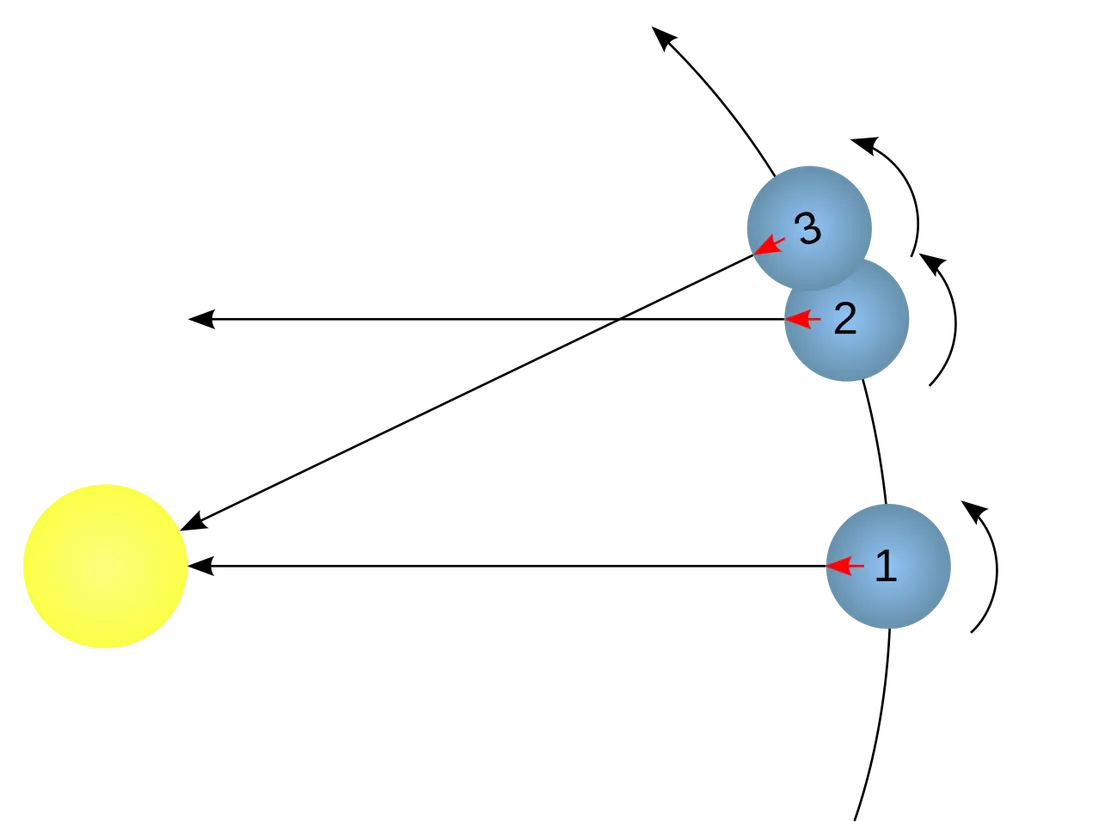
The specific values and relations are as follows:
| Quantity | Value (in mean solar time) |
|---|---|
| One mean sidereal day | 23h 56m 04.0905s ≈ 86164.0905 seconds |
| One mean solar day | 24h 00m 00s = 86400 seconds |
| Difference per day | About 3m 55.9s ≈ 3 minutes 56 seconds |
| Number of sidereal days per year | About 366.24 |
| Number of solar days per year | About 365.24 |
Over one year there is exactly one more sidereal day than solar days (366.24 − 365.24 = 1). This is because the Earth’s revolution around the Sun makes the vernal equinox “turn one extra time” relative to the Sun. The conversion factor between the two time units is:
1 mean solar time interval ≈ 1.0027379 mean sidereal time intervalsThe daily accumulation of 3 minutes 56 seconds also explains the annual variation of the night sky: each day a given star transits about 4 minutes earlier than the day before, about 2 hours earlier after about 30 days, returning to the original time after one year. This is precisely the fundamental reason why different constellations are visible in the night sky in different seasons; see diurnal and annual motion.
Like solar time, sidereal time also comes in uniform and non-uniform forms, the distinction being whether the reference vernal equinox includes nutation.
The difference between the two is called the equation of the equinoxes:
Equation of the equinoxes = apparent sidereal time − mean sidereal timeIts value is very small, on the order of within ±1.4 seconds, arising from the periodic perturbation of the equinox position by nutation. Apparent sidereal time is used when high precision is required, while mean sidereal time suffices for ordinary observation planning.
Sidereal time depends on the observer’s longitude, because the direction of the meridian differs at different longitudes.
Local mean sidereal time = GMST + east longitude Local apparent sidereal time = GAST + east longitude(east longitude positive, west longitude negative; 15° = 1h)GMST can be computed from Universal Time UT1 via a standard polynomial (whose leading linear term reflects the 1.0027379 rate ratio between sidereal time and UT1), and GAST is then obtained by adding the equation of the equinoxes. Most astronomical software has these formulas built in.
The reason sidereal time is central to observation planning is that it directly connects celestial coordinates with “the sky at this moment.” For any object on the celestial sphere, the following fundamental relation holds:
LST = H + RAwhere RA is the object’s right ascension, and H is the object’s hour angle, that is, the angular distance of the object relative to the local meridian, positive toward the west, measured in time units. This relation links the two coordinates (right ascension and hour angle) through the local sidereal time. Rearranging gives:
H = LST − RAFrom this several direct conclusions follow:
| Condition | Meaning |
|---|---|
H = 0, i.e. LST = RA | The object is at upper transit (crossing the meridian, at maximum altitude) |
H < 0 (LST < RA) | The object is east of the meridian, has not yet transited, and is rising |
H > 0 (LST > RA) | The object is west of the meridian, has already transited, and is setting |
LST = 0h (= RA of vernal equinox) | The vernal equinox is at upper transit, defining the origin of sidereal time |
Thus “an object transits when its right ascension equals the local sidereal time” is merely the special case of LST = H + RA when H = 0. When planning deep-sky imaging, one usually wants to shoot during the period around the target’s transit, when its altitude is highest and the line of sight passes through the thinnest atmosphere, minimizing extinction and seeing-induced jitter.
Universal Time (UT) is a family of time scales referenced to the Earth’s rotation and to the mean Sun; in essence it is the mean solar time at the Greenwich prime meridian. The common members are as follows:
| Name | Definition | Notes |
|---|---|---|
| UT0 | Obtained directly by a single station observing the Earth’s rotation | Not corrected for polar motion, slightly different at each station, now largely abandoned |
| UT1 | Universal Time after correcting UT0 for polar motion | Reflects the Earth’s true rotation angle, the basis for astronomical positioning |
| UT2 | UT1 further corrected for seasonal variations in rotation rate | Historically used for time dissemination, now rarely used |
| UTC | Coordinated Universal Time, defined by atomic clocks and kept close to UT1 | The global civil and timekeeping standard |
UT1 corresponds directly to the Earth Rotation Angle (ERA) and is strictly tied to the Earth’s hour angle and sidereal time; it is the scale that represents “where the Earth has actually rotated to” in astronomical positioning. But because rotation is non-uniform, UT1 is not a uniform time scale.
Coordinated Universal Time (UTC) is defined by atomic time; its second equals the second of International Atomic Time TAI and is therefore uniform. At the same time, through leap seconds, it is kept always within ±0.9 seconds of UT1. The difference between the two is denoted:
DUT1 = UT1 − UTC (|DUT1| < 0.9 s)When the Earth’s rotation has accumulated a deviation from atomic time such that |DUT1| approaches 0.9 seconds, the International Earth Rotation and Reference Systems Service (IERS) decides to insert a positive leap second at the end of June or December (after that day’s 23:59:59 comes 23:59:60, then 00:00:00 of the next day), bringing UTC back close to UT1. Since the current leap-second system was established in 1972, all leap seconds have been positive (because the Earth’s rotation is slowing in the long term); the system also allows removing one second (a negative leap second) if necessary, but this has never yet occurred. For everyday timekeeping that does not require precision better than 1 second, UTC can be used directly to approximate UT1.
To obtain truly uniform time scales decoupled from the Earth’s rotation, scales based on atomic frequency and on the equations of celestial motion were introduced.
UTC = TAI − n, where n is the (integer) number of leap seconds accumulated since 1972. Since January 1, 2017, n = 37 s, and this value remains unchanged until a new leap second is inserted.TT = TAI + 32.184 sThis constant arises from the offset between TT and Ephemeris Time when they were joined at the beginning of 1977. High-precision calculations such as planetary ephemerides and precession-nutation models all use TT as the time argument. The difference between TT and UT1 is denoted ΔT = TT − UT1, currently on the order of 70 seconds; it changes slowly as the Earth’s rotation varies and must be determined by observation.
The following table summarizes the mutual offsets among several uniform time scales (as of the leap-second status from 2017):
| Relation | Value | Nature |
|---|---|---|
TAI − UTC | 37 s | Integer, changes with leap seconds |
TT − TAI | 32.184 s | Fixed constant |
TT − UTC | 69.184 s | Changes with leap seconds |
ΔT = TT − UT1 | About 70 s (2020s) | Determined by observation, changes slowly |
For civil convenience, the world is divided by longitude into a number of time zones, with the same standard time used throughout each zone, usually UTC plus an integer number of hours (in a few regions, a half hour or 45 minutes):
Zone time (standard time) = UTC + time zone offsetNote the difference between zone time and an object’s true position. Zone time is divided by integer hours (and administrative boundaries), whereas an object’s position depends on the local time corresponding to the observer’s specific longitude. For example, cities at the eastern and western ends of the same time zone can have true local times differing by tens of minutes or even more than an hour (with all of China using UTC+8 as a typical example). When making a precise observation plan, one should use the observer’s true latitude and longitude to compute the local sidereal time and each object’s transit time, rather than using zone time directly. In addition, regions that adopt daylight saving time add another hour on top of standard time, which must be noted separately.
The Gregorian calendar has discontinuities such as months of differing lengths, leap years, and year boundaries, making it difficult to perform time-difference arithmetic directly. The Julian Date (JD) solves this problem with a continuously increasing count of days.
JD 2451545.0 = January 1, 2000, 12:00 TT (the epoch J2000.0, the standard reference epoch of modern astronomy).JD 2451545.25 = January 1, 2000, 18:00.Because JD values are very large (seven-digit integers), the following simplified forms are commonly used:
| Name | Definition | Starting point | Characteristics |
|---|---|---|---|
| Modified Julian Date MJD | MJD = JD − 2400000.5 | November 17, 1858, 00:00 | Begins at midnight, shorter value, most common in modern use |
| Reduced Julian Date RJD | RJD = JD − 2400000 | November 16, 1858, 12:00 | Still bounded at noon |
| Truncated Julian Date TJD | floor(JD − 2440000.5) | May 24, 1968 | Mainly used in spaceflight |
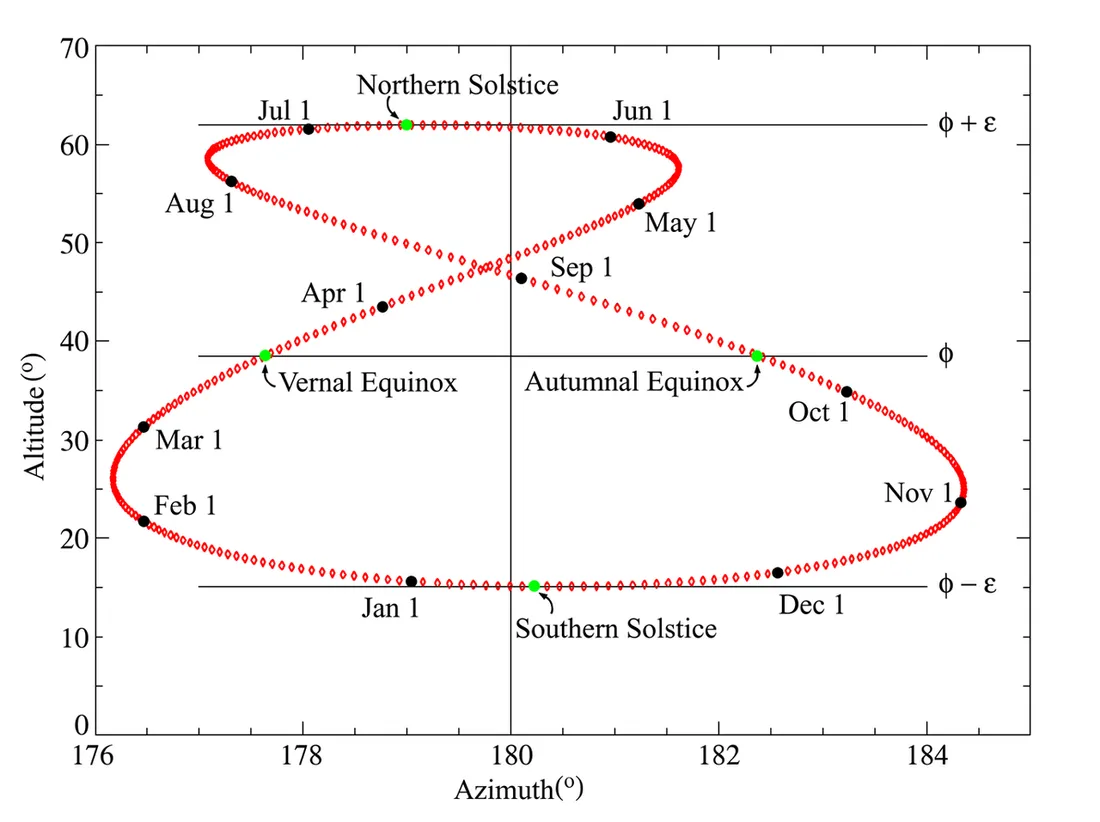
Because the length of the apparent solar day is non-uniform, there is a seasonally varying offset between apparent solar time and mean solar time, called the equation of time:
Equation of time = apparent solar time − mean solar time(Some references adopt the opposite sign, so the convention must be noted when using it. By this definition, when the equation of time is positive the sundial runs ahead of the clock.) The equation of time fluctuates over a year between about −14 minutes and +16 minutes, formed by the superposition of two independent causes:
| Cause | Physical origin | Period | Amplitude |
|---|---|---|---|
| Orbital eccentricity | The Earth’s orbital eccentricity is about 0.0167; it revolves faster near perihelion and slower near aphelion | One year | About ±7.66 minutes |
| Obliquity of the ecliptic | The obliquity of the ecliptic is about 23.44°; the projection of the Sun’s motion along the ecliptic onto the celestial equator is non-uniform in speed | Half a year | About ±9.87 minutes |
The two components have different periods and phases, and their superposition gives an irregular curve. The eccentricity component crosses zero around early January and early July, and the obliquity component crosses zero near the equinoxes and solstices. The typical extrema and zero crossings near epoch 2000 are as follows:
| Date (approximate) | Equation of time | Type |
|---|---|---|
| About February 11 | About −14 min 15 s | Annual minimum |
| About May 14 | About +3 min 41 s | Secondary maximum |
| About July 26 | About −6 min 30 s | Secondary minimum |
| About November 3 | About +16 min 25 s | Annual maximum |
| About April 15, June 13, September 1, December 25 | 0 | Zero crossing (apparent and mean solar time equal) |
If you photograph the Sun at the same clock time at the same location every day and superimpose the images over a whole year, the Sun traces a figure-eight curve in the sky, called the analemma: the horizontal offset comes from the equation of time (angular width about 7.7°), and the vertical variation comes from the seasonal change of the Sun’s declination (±23.44°). The asymmetry of the figure-eight’s two loops arises precisely from the superposition of the two causes, eccentricity and the obliquity of the ecliptic.
By combining the systems above, one can determine when an object transits and whether it is visible.
① Find the local sidereal time
From the current UTC (or UT1) and the observer’s longitude, compute the present local sidereal time LST.
② Compare with right ascension
When LST ≈ object's right ascension RA (hour angle H = 0), the object is at upper transit, in the best observing position.
③ Compute the transit altitude
Combining the object’s declination δ with the observer’s latitude φ: transit altitude ≈ 90° − |φ − δ|.
④ Estimate the visibility window
Require the altitude to be above the horizon and the time to be after astronomical twilight; the longer the night and the higher the target, the better.
For example: the Andromeda Galaxy M31 has a right ascension of about 00h 43m. When the local sidereal time is close to 00h43m it transits; on an autumn night at mid-northern latitudes this usually happens around midnight, which is a good time to image it. Visibility also depends on declination and the observing latitude; see hemisphere visibility. For the target’s brightness and the required exposure, refer to magnitude and catalogs and naming.
Once you understand the time systems, you can go further and combine them with an object’s position to judge which targets are visible at your latitude and when they are highest. Continue reading observing conditions and observation planning to integrate time and position into a complete observation plan.
LST = H + RA relation.TT = TAI + 32.184 s, and the 37-second leap-second accumulation from 2017.