LMC · Large Magellanic Cloud
| Chinese name | 大麦哲伦云 |
|---|---|
| Type | Dwarf galaxy |
| Constellation | Dor |
| RA | 05h24m |
| Dec | −70° |
| Apparent magnitude | 0.9ᵐ |
| Hemisphere | Southern |
| Best season | Winter |
| Difficulty | Easy |
| Focal length | 广角 24–135mm |
About
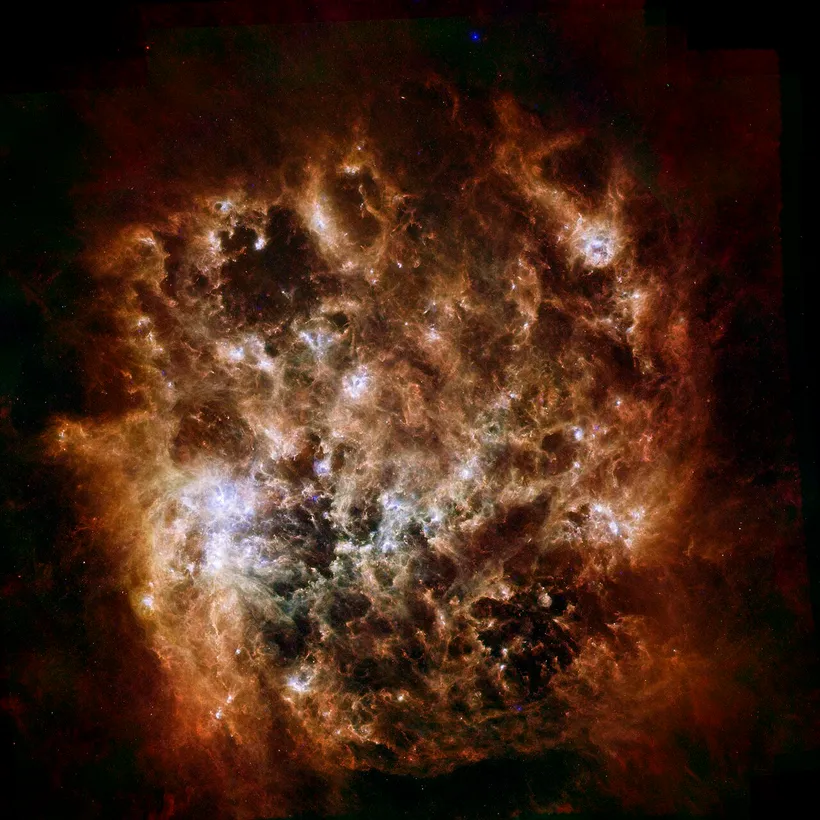
The Large Magellanic Cloud lies about 160,000 light-years away and is the Milky Way's largest satellite dwarf galaxy, visible to the naked eye as an isolated patch of haze in southern skies. Home to tens of billions of stars, it harbors the Tarantula Nebula (30 Doradus), the most spectacular star-forming region in the entire Local Group. It also hosted SN 1987A, the closest naked-eye supernova of modern times and a milestone for astrophysics. The LMC orbits the Milky Way together with the Small Magellanic Cloud, the two linked by the gaseous Magellanic Stream. A wide field captures the whole cloud, while longer focal lengths reveal countless embedded nebulae and clusters, making it an essential southern-hemisphere imaging target.