M42 · Orion Nebula
| Chinese name | 猎户座大星云 |
|---|---|
| Type | Emission nebula |
| Constellation | Ori |
| RA | 05h35m |
| Dec | −05° |
| Apparent magnitude | 4ᵐ |
| Hemisphere | Both hemispheres |
| Best season | Winter |
| Difficulty | Easy |
| Focal length | 中焦 400–800mm |
About
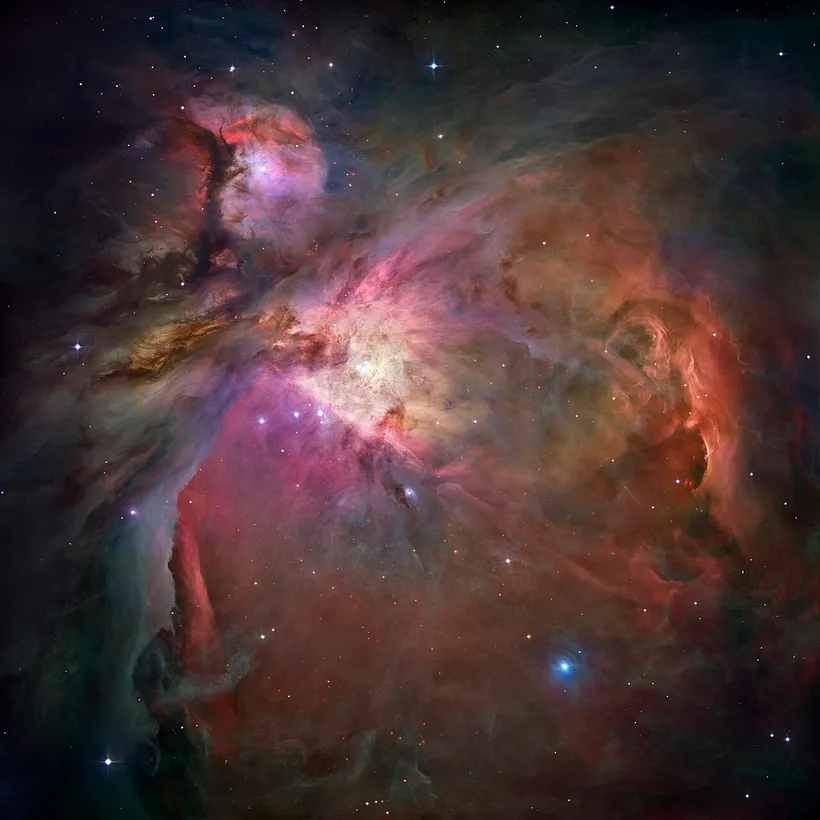
The Orion Nebula lies about 1,340 light-years away and is the nearest region of massive star birth, as well as the brightest and easiest diffuse nebula to photograph, visible to the naked eye below Orion's Belt. It is an ionized hydrogen region roughly 24 light-years across, lit and ionized by the Trapezium multiple star at its core, glowing in vivid pink-red and blue-green hues. The nebula hosts hundreds of forming stars and protoplanetary disks (proplyds), making it a natural laboratory for studying star and planet formation. Its high surface brightness and enormous dynamic range yield images in short exposures, though deep shots need HDR blending to preserve the core. It is the classic first target in astrophotography, delivering striking results with almost any equipment.